Photo of a car producing black gas captioned 'Transport emissions in australia'

What’s the deal with transport emissions?

This content is 9 years old.

While greenhouse gas emissions from Australia’s electricity sector have received significant media and political attention in recent years, the transport sector – a large and growing source of emissions – has largely escaped the spotlight.

Here we outline the problem of transport emissions and key climate solutions.

Transport: second largest emitter, highest emissions growth

Transport – cars, trucks, public transport, domestic flights and shipping – is Australia’s second largest source of greenhouse gas pollution. The sector emitted 102 million tonnes carbon dioxide (MtCO2) in 2018, representing 18% of Australia’s annual greenhouse gas pollution.

Transport emissions have the highest rate of growth of any sector since 1990. With no action, transport emissions are projected to continue growing to 2030 (expected to reach 111 MtCO2 by 2030).

The major source of the problem is cars, responsible for roughly half of Australia’s greenhouse gas pollution from transport. In fact, Australian cars emit roughly the same per year as Queensland’s entire coal and gas fired electricity supply.

How does Australia compare on transport emissions?

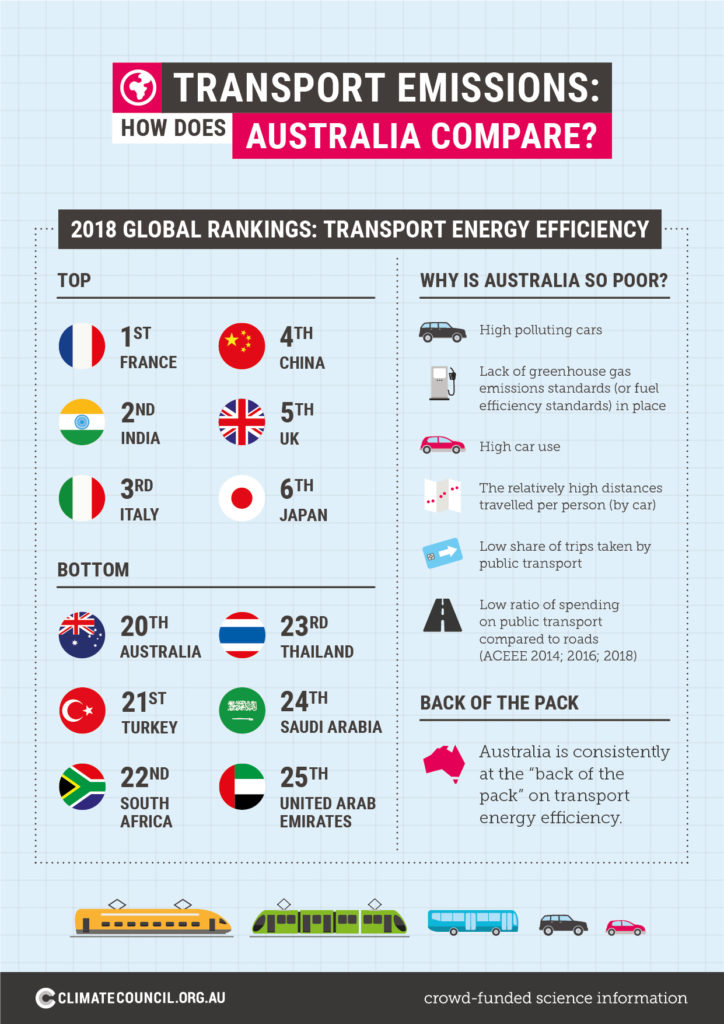
Australia lags well behind the global pack when it comes to tackling transport emissions. In fact, on international scorecards, Australia lags behind Russia, Mexico and Indonesia on transport energy efficiency. The reasons for Australia’s poor performance include:

  • High polluting cars
  • Lack of greenhouse gas emissions standards
  • High car use
  • Relatively high distances travelled per person by car
  • Low share of trips taken by public transport
  • Low ratio of capital spending on public transport compared to roads

Your contribution can accelerate our push for climate action in Australia. Chip in to power our work on transport impacts and solutions.


What are the solutions to transport emissions?

There are solutions available now to drive down greenhouse gas pollution from transport. These include:

  • Providing viable alternatives to driving, such as expanding access to reliable, comfortable public transport, cycling and walking alternatives.
  • Electrifying and powering cars, buses, trains and light rail with 100% renewable energy.
  • Adopting policies and incentives to encourage lower emitting vehicles, such as mandatory greenhouse gas emissions standards and electric vehicle targets.
 

For more information, check out our report Waiting for the Green Light: Transport Solutions to Climate Change.

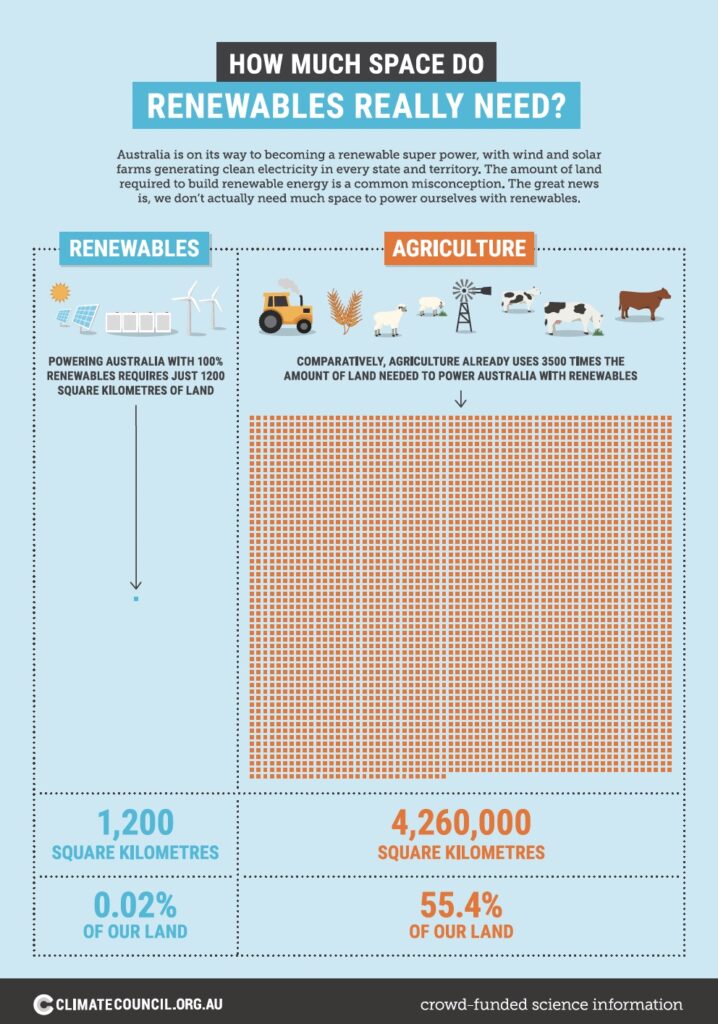
 

How much space do renewables really need?

Australia is on its way to becoming a renewable super power, with wind and solar farms generating clean electricity in every state and territory. The amount of land required to build renewable energy is a common misconception. The great news is, we don’t actually need that much space to power ourselves with renewables.

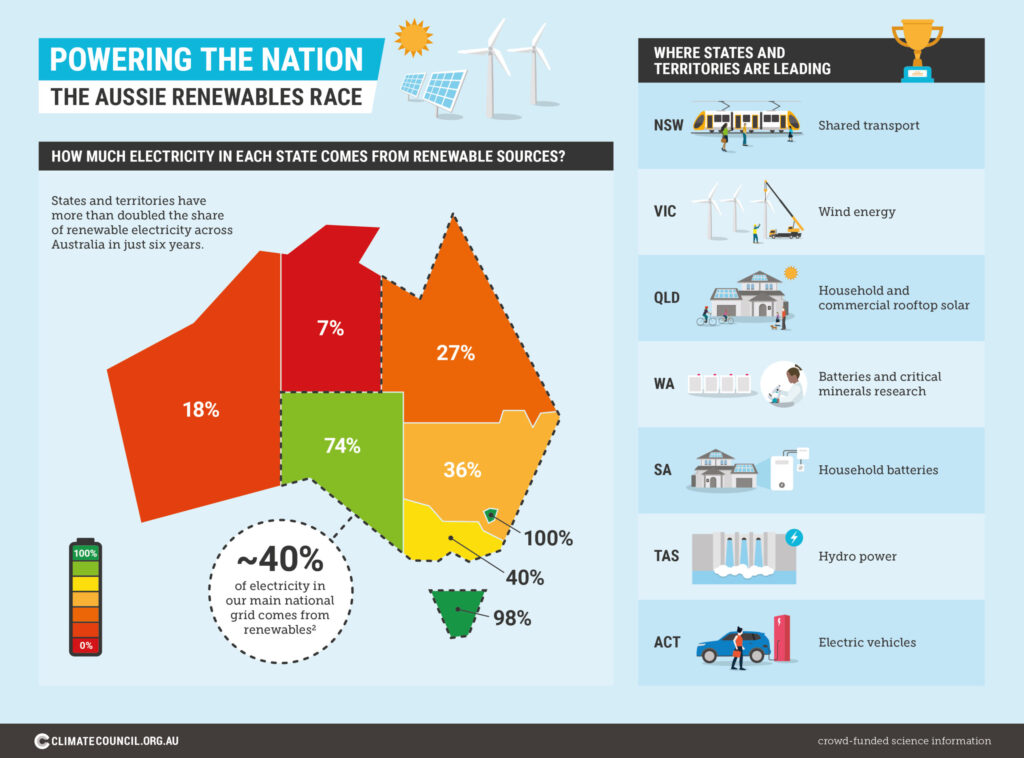
2024 progress scorecard: How states and territories measure up

Nowhere is our rapid shift towards an economy powered by renewable energy more visible than at the state and territory level, where governments, communities and households are leading the charge. This transformation is dynamic, with different states and territories leading the way on different aspects.

What is coral bleaching infographic

Coral reefs are highly vulnerable to climate pollution. Warmer ocean temperatures and other stressors cause coral bleaching events which can damage and destroy coral reefs and the ecosystems the support. Mass coral bleaching is a recent phenomenon. The first global bleaching event occurred in 1998.

How Polluting is Australia vs UAE

Australia continues to fuel the climate crisis through its enormous fossil fuel exports. Australia is the world’s fifth largest overall producer of coal and seventh biggest producer of gas (UNEP 2023a). Most of this is not needed for our own energy needs, and is sold offshore. That’s why Australia is the world’s third largest fossil fuel exporter.

The Climate Crisis is an oceans crisis

The ocean is at the heart of the earth’s climate system. this means climate change – driven by the burning of coal, oil and gas – is rapidly transforming our oceans as well as our climate.

Electric Ute parked in front of wind turbines

Electric utes available now and in the future

Utes have long been part of work life in Australia, used in particular for construction, mining and agriculture. Some drivers also use them for convenience and recreation, with utes now making up one in five new car sales. The good news is zero emissions electric utes are on the way.