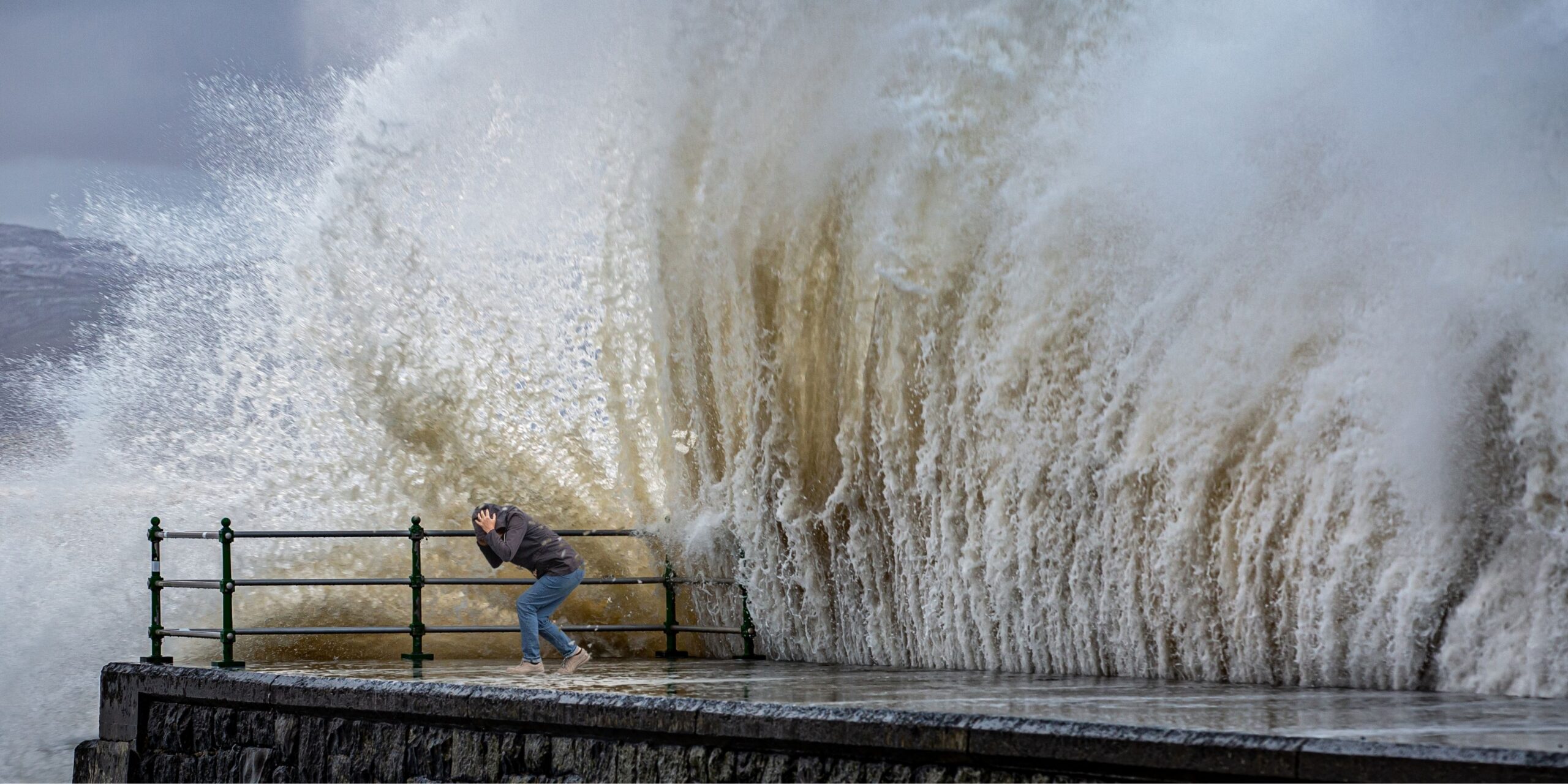
As climate change worsens, extreme sea level events that are rare today will become much more frequent. Already, we are witnessing the erosion of our beaches, permanent inundation in low-lying areas, and coastal flooding events becoming more frequent and intense.
The consequences of sea level rise, and coastal flooding will be significant – for our societies, culture and economy. Already, it is damaging people’s homes, our coastal infrastructure and precious ecosystems. We are poorly prepared for what’s already here, and few people are aware of what’s at stake, what can be done about it or how to avoid even worse impacts into the future.
This report draws on new research from the University of Melbourne, recently published in the Nature journal Scientific Reports, to quantify the potential economic losses from sea level rise in Australia (Kompas et al. 2026).
Key Findings
- Our analysis finds total economic losses from coastal flooding will reach $855.1 billion this century made up of $274.3 billion in property losses and $580.7 billion in land use damages.
- The losses would be a sustained annual economic drag large enough to potentially cost Australian jobs and push down household incomes.
- Climate pollution from burning coal, oil and gas is overheating our planet and causing ice sheets to melt, and oceans to warm and expand. Sea levels have already risen, with scientists confident at least a further 14 cm rise is locked in by 2050.
- This analysis is based on a conservative scenario where countries implement existing policies to cut climate pollution. Actual sea level rise could be far higher, especially if climate pollution isn’t cut deeply enough and glaciers and ice sheets collapse faster than expected.
- Floods that were considered severe will become a regular consequence of ordinary tides, with every 10 cm of sea level rise tripling the frequency of so-called ‘once-in-a-century’ flood events. In Sydney, for example, minor coastal flooding that now occurs for just over a week each year will become a daily occurrence by 2100 under a high-polluting scenario.
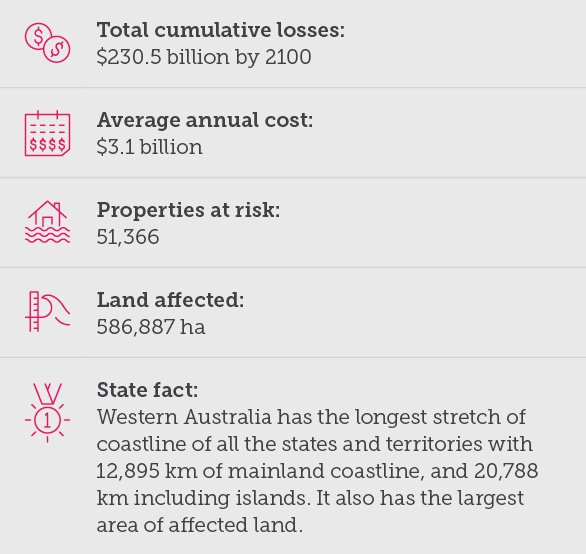
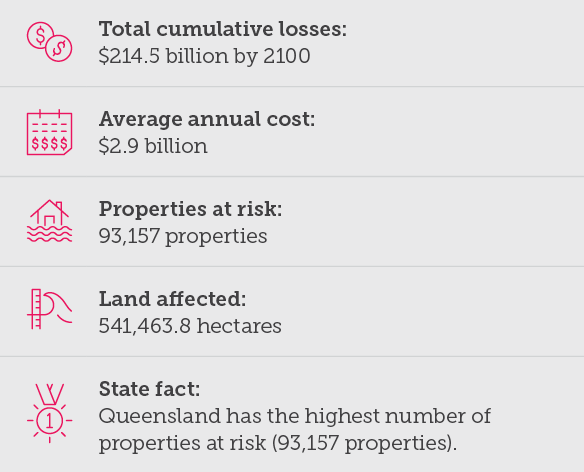
- Queensland has the greatest number of homes at risk (93,157 properties) followed by New South Wales (71,210) and Western Australia (51,366).
- Queensland’s Gold Coast alone faces $84.4 billion in projected economic losses — the single most exposed urban area in Australia.
- Land facing damages spans residential and commercial properties, nature reserves, industrial and agricultural areas and critical infrastructure. Of the 619,713 hectares of farming land that’s damaged, the highest losses are concentrated in Western Australia, the Northern Territory and Queensland.
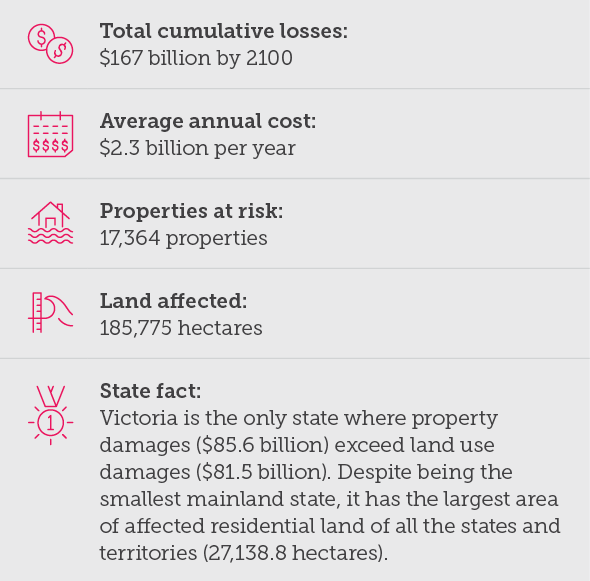
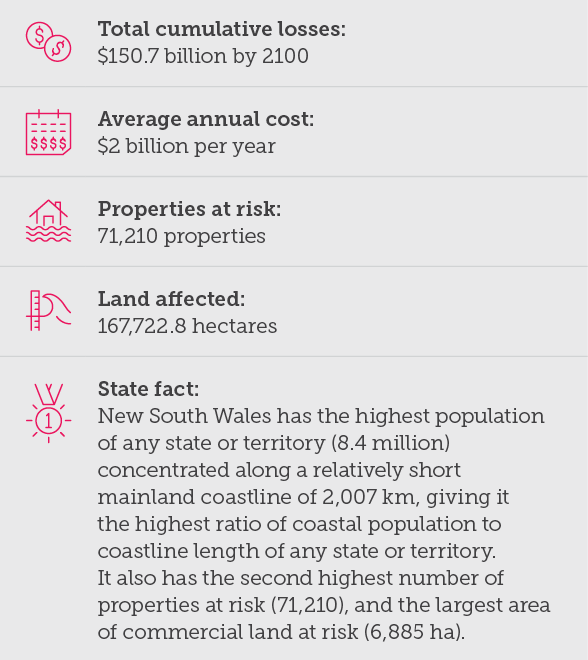
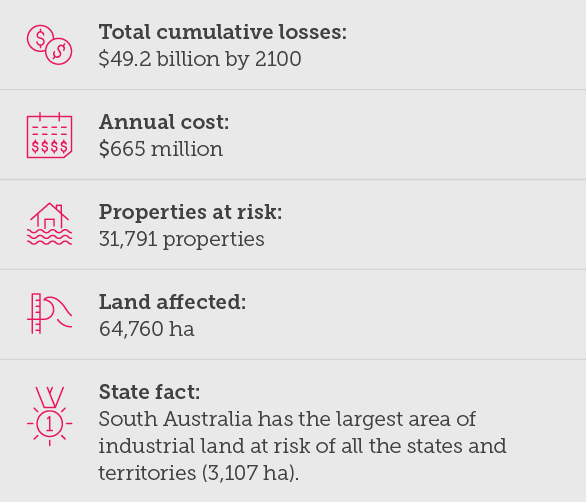
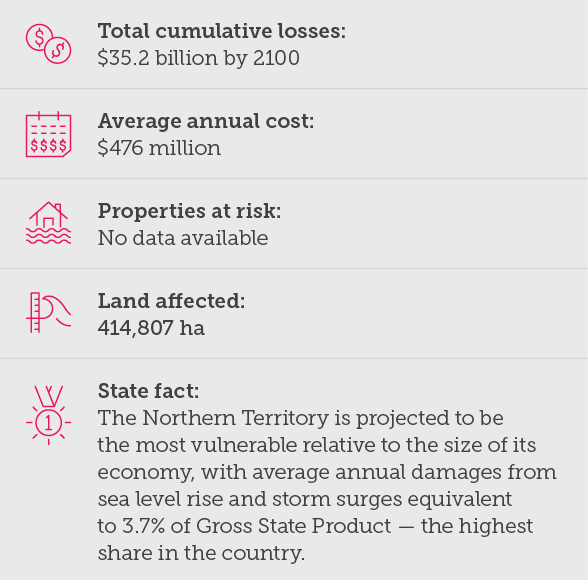
- Western Australia faces the largest total losses at $230.5 billion. However, no state escapes: with $214.5bn in losses in Queensland, $167.1bn in Victoria, $150.7bn in NSW, $49.2bn in South Australia, $35.2bn in the NT and $7.9bn in Tasmania.
- In New South Wales, communities in Northern NSW and Central Coast face higher property losses than in Greater Sydney – with 71,210 properties at risk across the state; the second highest nationally.
- In Victoria, losses are heavily concentrated in low-lying areas of Melbourne around Port Phillip Bay and the Yarra River.
- Most private insurers don’t cover ‘actions of the sea’ — meaning when coastal flooding strikes, property owners will largely bear the costs alone.
- Coastal communities are already dealing with disappearing beaches, homes falling into the sea and a damages bill that’s becoming unmanageable. In NSW’s Central Coast a proposed seawall to protect 40 houses remains unbuilt because of a dispute over who should pay the $40 million cost.
- Governments can avoid some costs by stopping development in at-risk areas, and managing retreat in the most vulnerable places. However, with significant sea-level rise already locked in, someone must pay for further damages with the Insurance Council of Australia estimating at least $30 billion is needed in large scale coastal protection and adaptation projects, over the next 50 years alone.
- Right now, it’s everyday Australians who are wearing these costs. Australia’s 537 local councils have voted unanimously that coal, oil and gas corporations – whose pollution worsens sea level rise – should help foot the bill.
- Regardless of who pays, responding to rising seas while continuing to pollute is like bailing water without patching the leak.
- Immediate opportunities for Australia to cut climate pollution further and faster are:
- Ending coal and gas expansion;
- Closing loopholes in our national industrial law, which are being exploited by coal and gas corporations.
- Redirect billions in tax breaks for mining corporations through the Fuel Tax Credit Scheme, which could be reinvested in better preparing communities.
how much will sea level rise cost australia?
Rising seas and storm surge are projected to cost Western Australia at least $230.5 billion by 2100.
Economic losses are dominated by damage to land use, and farming is the single largest land-use category affected (203,116.8 ha, 34.6% of the state’s total), ahead of reserves (174,790.4 ha, 29.8%).
Rising seas and storm surge are projected to cost Queensland at least $214.5 billion by 2100.
Across the entire state, damages are split almost evenly between land use ($114 billion) and property ($101 billion), but this varies enormously region to region.
Rising seas and storm surge are projected to cost Victoria at least $167 billion by 2100.
Unlike every other state, Victoria’s economic losses are dominated by property rather than land. This reflects the state’s concentration of valuable coastal real estate around Port Phillip Bay.
Rising seas and storm surge are projected to cost New South Wales at least $150.7 billion by 2100, with economic losses from land ($113.2 billion) far outweighing economic losses from property ($37.5 billion).
Farming land makes up the single largest share of NSW’s affected land (68,794 ha, 41%), followed by reserves (42,738 ha, 26%) and parks (25,676 ha, 15%).
Rising seas and storm surge are projected to cost South Australia at least $49.2 billion by 2100.
Land-use damages ($34.8 billion) exceed property damages ($14.4 billion).
Rising seas and storm surge are projected to cost the Northern Territory at least $35.2 billion by 2100.
Because comprehensive property data is not available for the Territory, these losses are driven entirely by land-use damages.
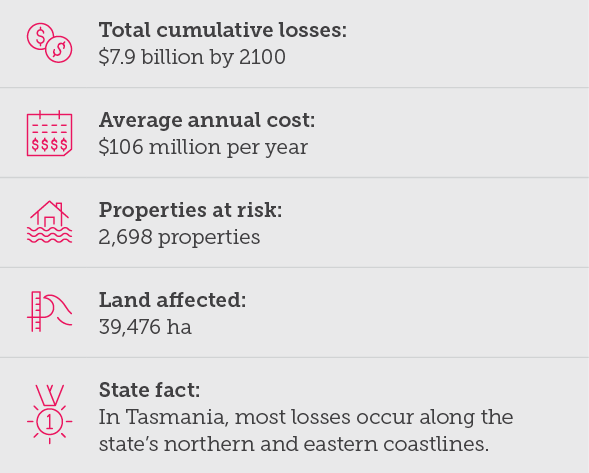
Rising seas and storm surge are projected to cost Tasmania at least $7.9 billion by 2100.
Whilst this is the lowest of any state or territory, it is a considerable amount given Tasmania’s smaller population and economy. Land-use damages ($6.8 billion) dominate losses over property damages ($1.1 billion).