Data centres are behind many of the modern conveniences we enjoy: social media, online shopping, streaming TV shows, cloud storage, navigation apps – the list goes on. Data centres also underpin essential services: from transport and logistics, to hospitals and defence.
But right now, a new wave of data centre development, driven in large part by a surge in demand for artificial intelligence (AI), presents challenges for our critical shift to renewable energy. The scale and pace of new development will shape our energy system (and power bills!) for decades to come, with the latest forecasts predicting the industry’s energy demand will increase seven-fold by 2036. Data centres can also require significant volumes of water, with industry estimates suggesting water demand will triple by 2030. As climate change intensifies drought and water stress across Australia, unchecked growth could place increasing pressure on already constrained water resources.
The Albanese Government is drafting new laws for AI and data centres right now, and has committed to require large data centres to bring on new renewable energy and firming to fully offset their demand. But the devil will be in the detail: to protect Australians from worsening climate harm and rising costs, data centres must be required to bring on genuinely additional renewables urgently, and keep polluting and expensive fossil gas out of the picture as a primary power source. These rules must apply to all data centres, everywhere in Australia – including those already in the pipeline.
Now the Government needs to make sure its legislation delivers on its promises, and doesn’t leave the door open for harmful proposals that will lock in more expensive fossil fuels and climate pollution.
Sources: AEMO 2026; Baringa and CEFC 2025; Climate Council estimates of future water demand based on energy demand forecasts and average industry water and energy efficiency.
Here are 10 key things to know about centres and our climate, and what governments should do about it.
What are data centres?
Data centres are buildings that run all day, every day, to process, store, and manage digital data. They house equipment like servers, routers, switches, firewalls, and storage systems. There are different types of data centres, with different functions and needs. Traditional data centres, which have been in Australia for decades, are much smaller than the hyperscale facilities and AI factories now being built to meet the needs of large cloud computing, IT and increasingly AI providers.
For example, AI giant Anthropic has announced a deal with the proposed Western Downs Digital Park in Queensland. Western Downs Digital Park has the potential to use up to 3.24GW of power in total – that’s over three times more power than Australia’s current largest energy user, Tomago Aluminium smelter.
How many data centres are in Australia?
Australia is already home to around 165 operational data centres. Australia has long been a leading global destination for data centre investment, supported by our relative regulatory and political stability, skilled workforce, abundant renewable energy potential, proximity to Asia, and availability of land compared to many other jurisdictions.
How many more data centres are going to be built in Australia?
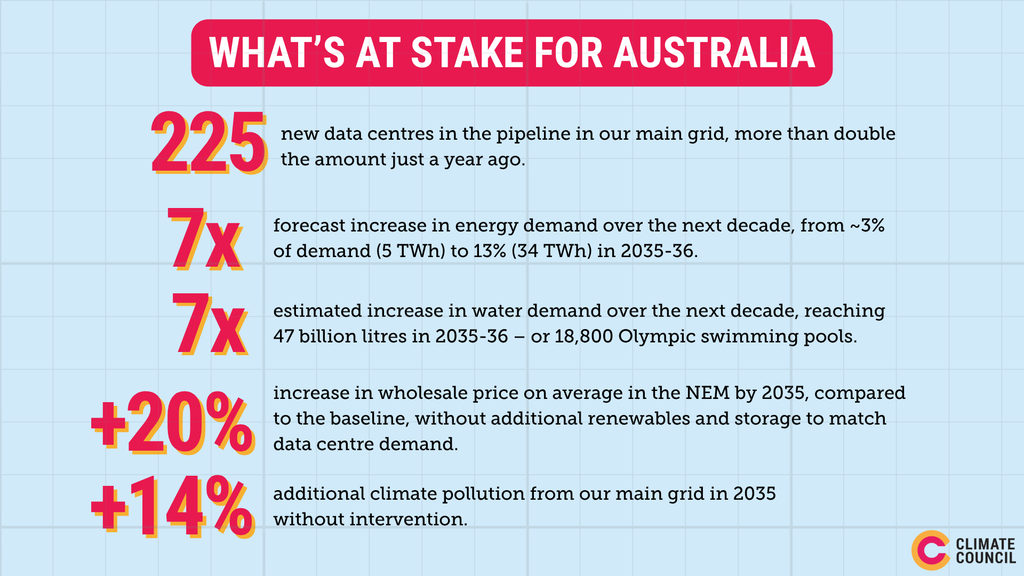
The data centre boom is moving fast: there are now at least 225 more data centres being proposed in Australia, more than double the number 12 months ago. Most data centre development is centred in NSW and Victoria, but there are significant data centre proposals in other states and territories too. For example, the Project Ares data centre in the Northern Territory could use more gas than the entire NT, and release more than a million tonnes of climate pollution every year.
However, not all of the proposed data centres are expected to be built. There is significant uncertainty in Australia’s data centre forecasts, creating challenges in planning for future energy and water demand.
Data centre proposals are popping up in every state and territory
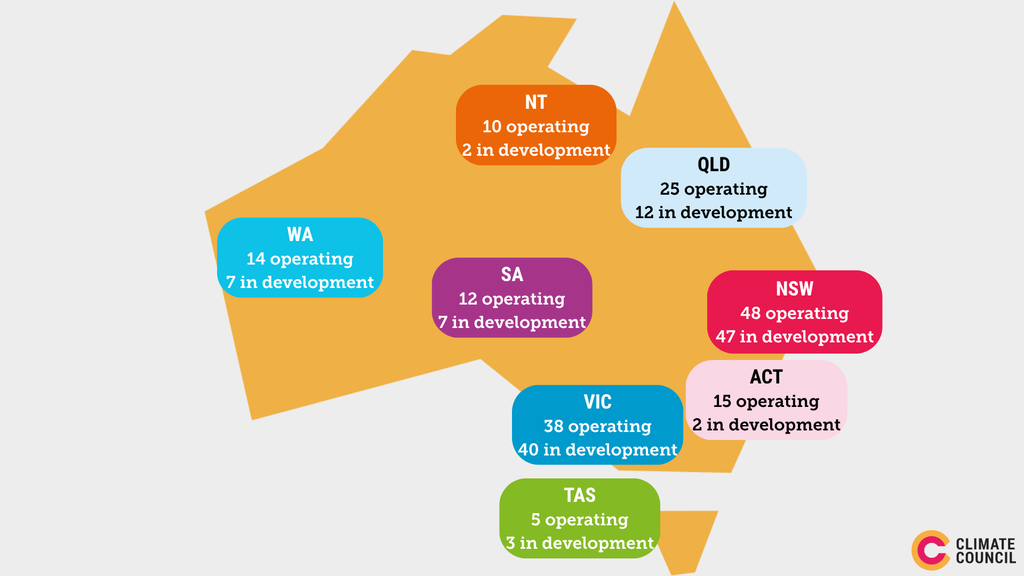
Source: RenewMap as at 14 October 2026. Figures are based on publicly available proposals only, and don’t capture the full 225 proposals that AEMO has documented.
Why are so many new data centres coming to Australia?
Emerging data centre growth in Australia is driven in large part by AI, as well as cloud computing. In Australia, data centre infrastructure is often developed and operated by a specialist provider, but leased to one or more other customers – increasingly hyperscale cloud and AI firms – who house and operate their own IT equipment in the data centre. OpenAI, Anthropic, Amazon and Microsoft have all announced commitments to build AI capacity in Australia.
How much energy will data centres use?
In its latest official forecasts, the Australian Energy Market Operator (AEMO) expects data centre energy demand in the NEM to increase seven-fold within the next decade – from around 3% of demand in 2025-26, to 13% of demand in 2036. That is equivalent to nearly every home in NSW and Victoria combined. A year ago, AEMO hadn’t expected that level of energy demand until 2050.
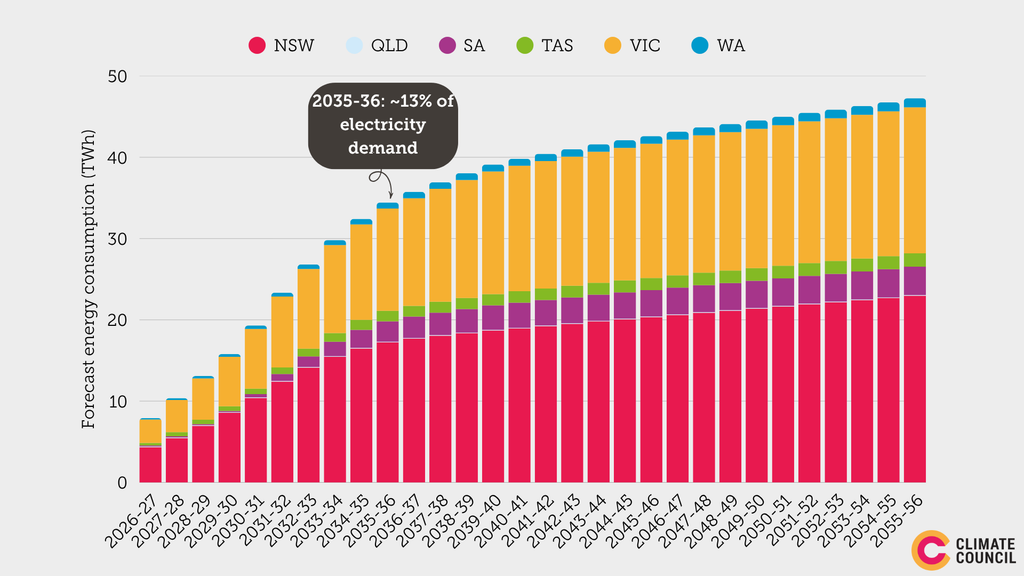
Source: AEMO 2026 (Step Change Scenario)
How much water will data centres need?
The industry estimates that it currently uses less than 0.1% of Australia’s total water. In Sydney, the share is greater: 0.7%, while data centres use 0.2% of Melbourne’s water supply.
Based on energy demand forecasts and average industry water and energy efficiency, Climate Council estimates that the industry’s water demand will increase around 7x over the next decade, reaching 47 billion litres in 2035-36 – or 18,800 Olympic swimming pools.
As climate change intensifies drought and water stress across Australia, unchecked growth could place increasing pressure on already constrained water resources. That’s why it’s critical that data centres are required to adopt best-practice water efficiency measures, and avoid drawing on drinking water supplies
Could data centres increase power prices?
If data centre growth is not matched with new renewable generation and storage, this could increase wholesale prices by more than 20% across our main grid by 2035, on average. These projected increases are due largely to the increased reliance on expensive and polluting fossil gas. With wholesale prices making up around 40% of a typical residential power bill, this could significantly impact households and businesses.
The potential impacts are not confined to states with significant data centre development: South Australia and Tasmania would also be impacted despite limited added data centre load in these states, as their generation would be exported to other states to meet demand.
These impacts can be significantly reduced if we match new data centre load with additional renewable generation, while adding storage to reduce reliance on peaking gas in the evenings would further limit increases and avoid material increases to climate pollution.
Data centres could send power prices surging within the next decade if not matched with renewables and storage
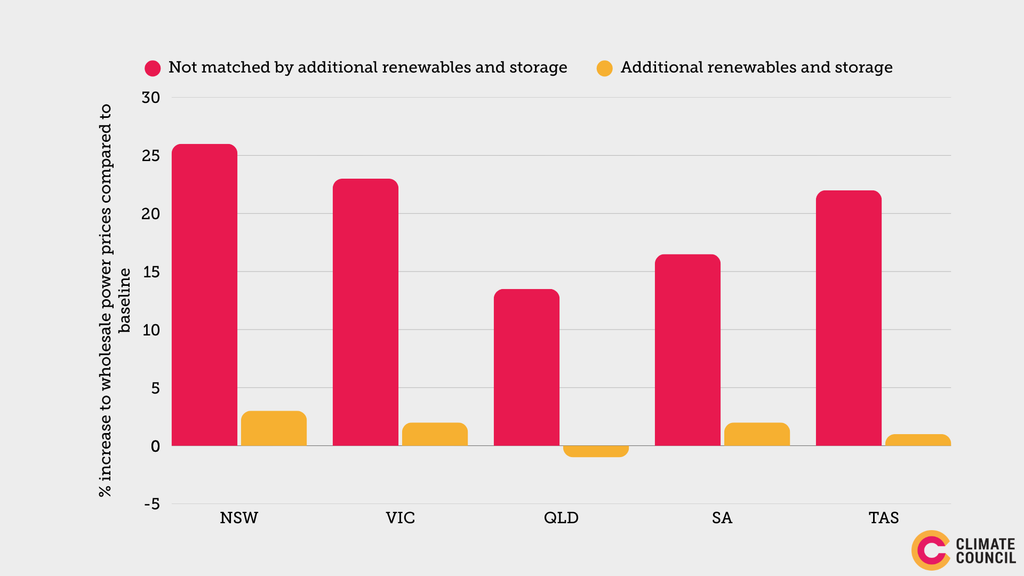
Projected price increases in 2035 compared to the baseline. Source: Baringa and CEFC 2035
What do data centres mean for our energy and climate targets?
If surging data centre energy demand is not met with an equivalent increase in additional renewable energy, Australia faces a critical setback in our shift to renewables. We will need to rely on coal for longer, and increase gas generation. Rapidly growing electricity demand from AI and data centres is emerging as a significant challenge to achieving deeper cuts in climate pollution.
Right now, the data centre industry’s climate pollution is already growing, driven largely by its rapidly expanding energy consumption, at a time when Australia’s climate pollution needs to be falling rapidly.
Modelling by Baringa indicates that if data centres are built without additional renewable capacity, NEM climate pollution could be 14% higher than it would otherwise be in 2035. These impacts are avoidable if we put the policies in place to ensure data centres are powered by additional renewable and storage.
SHOULDN’T DATA CENTRES BE ABLE TO CHOOSE THEIR OWN POWER, AS LONG AS THEY’RE PAYING FOR IT?
Meeting data centre energy demand with polluting, expensive and unreliable technologies would increase costs for operators, their customers, and the community. Here’s why coal, gas and nuclear don’t stack up:
- Extending coal will not provide a secure foundation for a new wave of electricity demand from data centres. Our coal fleet is old, increasingly unreliable and already scheduled to retire. Coal outages are a primary driver of blackout risk, and unplanned outages have contributed to some of the worst electricity price spikes in recent years.
- Gas is a highly polluting and harmful fossil fuel that has a small and shrinking role to play in Australia’s energy mix. It is expensive and volatile, while waiting lists for new gas turbines have blown out five or more years, into the 2030s. More gas generation is far from a quick fix, and would lock in higher power costs and climate pollution for everyone across the system – including data centre operators.
- Developing nuclear energy in Australia would be slow, expensive and risky. Nuclear reactors would take at least 15 years to get up and running in Australia – far longer than data centre development timeframes – and would cost at least twice as much as firmed renewables.
Renewables are the cheapest form of power, and developers know this: data centre operators already voluntarily offset 70% of their energy use with renewables, because it makes commercial sense. But given what’s at stake, governments must move beyond voluntary signals to enforceable, nationally uniform requirements.
What should governments do about it?
If we get them right, nationally enforceable standards can avoid unnecessary increases in power bills and climate pollution, and strain on our water resources. The vast majority – 82% – of Australians agree that data centres should be required to invest in additional renewable energy and storage to match their own electricity use – not be allowed to use whatever kind of electricity they want.
To protect Australians from worsening climate harm, rising costs and water stress, the Australian Government’s national standards must:
- Make sure that every new data centre and its customers match no less than 100% of their energy use with genuinely new renewable power and storage.
- Ensure new renewable generation and storage is built within three years – not a long or unlimited window – with penalties for non-compliance.
- Close the door on off-grid gas as a primary power source for data centres – including while they set up new renewable energy sources.
- Require data centres to adopt best-practice water and energy efficiency measures, and avoid drawing on drinking water supplies.
- Make the rules retrospective so they apply to every new data centre and its customers, everywhere in Australia – including facilities already in the pipeline.
Now we need your help! It’s going to take a critical mass of public support to get the Government to act. We’re stronger together. 💪

support climate action
Trusted. Independent. Influential.
The Climate Council is 100% independent and funded entirely by our community. That means we speak to the facts, the evidence and the science without government or corporate influence.