In Australia, an already overheated climate and El Niño are a dangerous double act.
Weather services including the UK’s Met Office have warned the current El Niño is on track to become the strongest since records began early last century, which has implications for floods, drought and heat in certain regions around the globe. For Australia, while El Niño does load the dice for hotter and drier conditions, the strength of El Niño does not always correspond to the strength of Australian impacts, due to several other climate drivers at play at the same time. This includes the warmth of surrounding oceans, temperatures in the Indian Ocean, weather patterns over the Southern Ocean, and climate change from the burning of coal oil and gas.
IN SUMMARY
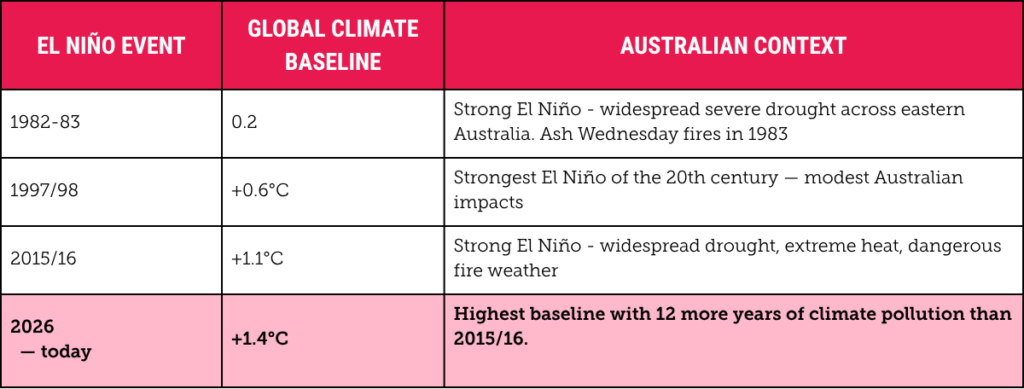
The story is not just that this El Niño may be the strongest yet. It’s that climate pollution from coal, oil and gas is supercharging all of its impacts because the world is already 1.4°C hotter (Copernicus 2026).
Think of a loaded dice: Climate pollution is weighting those dice, stacking the odds for record breaking heat, flash drought and dangerous fire weather in Australia.
What’s El Niño Again?
El Niño is a natural, periodic shift in tropical Pacific Ocean temperatures — warmer waters near South America, cooler near Australia — that alters global weather patterns for several months.
It occurs every 2–7 years and in Australia raises the risk of hotter temperatures, reduced rainfall, drought, elevated fire risk and coral bleaching, especially in the east and south (NOAA 2016, BoM 2021).
No two El Niño events are the same. This event will make dry conditions more likely in Eastern Australia, but rain events can still occur. And because a hotter atmosphere holds more moisture, flash floods remain possible during an El Niño as was experienced in eastern Victoria and southern New South Wales in 2023.
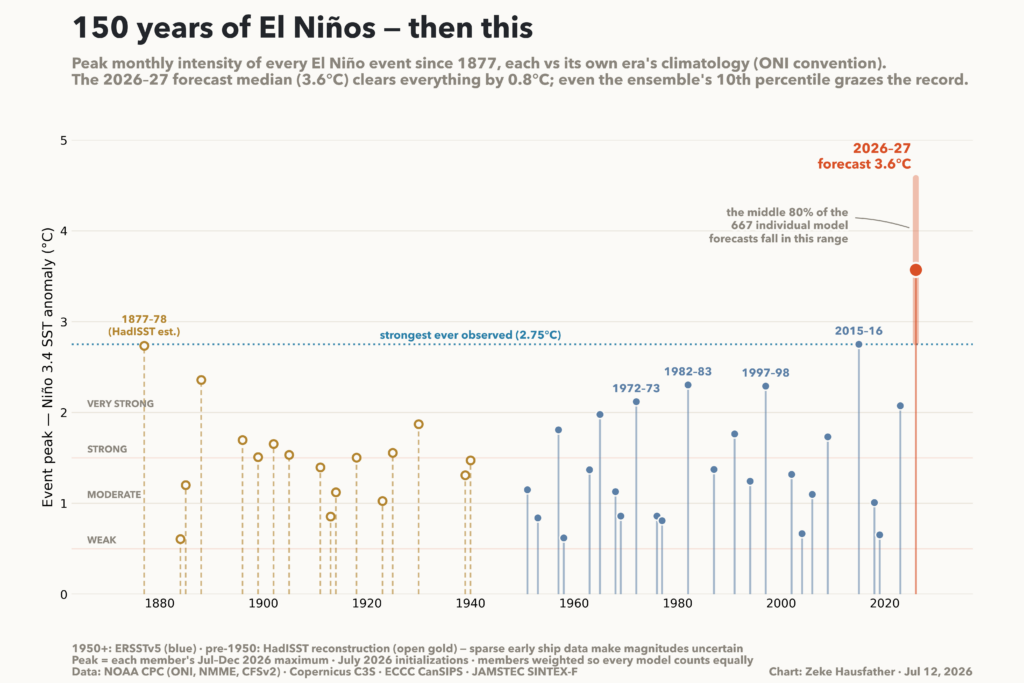
An El Niño is considered strong when Pacific sea surface temperatures exceed 2°C above average; however some international weather agencies are forecasting sea surface temperatures 3°C above average later in 2026. This would rank 2026 as the strongest El Niño event on record (Perry 2026). Australia’s Bureau of Meteorology warns this event is likely to persist into Autumn 2027.
There is no official category for a ‘Super El Niño’, and the strength of the El Niño event does not guarantee specific impacts, or how they will be felt, in Australia. What is certain is that climate pollution is now shaping all our weather, raising the odds of extreme weather events. As both climate change and El Niño raise the odds of hot and dry conditions in Australia, each El Niño risks worse impacts than the last.
Watch climate scientist and Councillor David Karoly explain how climate change interacts with El Niño, what Australia can expect, and the key risks for our communities and environment:
WHY IS THIS EL NIÑO IS DIFFERENT?
The 11 hottest years on record globally have all occurred since 2010. We’ve entered El Niño from a baseline that is 1.4°C hotter than pre-industrial levels — with global atmospheric carbon dioxide levels now over 425 parts per million, the highest in at least 400,000 years (NASA 2026).
Triple Threat?: El Niño events that align with a positive Indian Ocean Dipole (IOD) tend to hit Australia hardest. Models suggest that a positive IOD may occur during the southern hemisphere spring (Copernicus 2026). When these two climate drivers align they typically compound fire weather, drought and heat across eastern and southern Australia. This creates a scenario of a “triple threat” of climate pollution, El Niño and a positive Indian Ocean Dipole acting together. Another climate driver, the Southern Annular Mode that controls winds swirling around the Antarctic, was a major driver of the 2019 / 2020 Black Summer bushfires.
WHEN CLIMATE POLLUTION AND EL NIÑO COMBINE
Drought becoming more aggressive
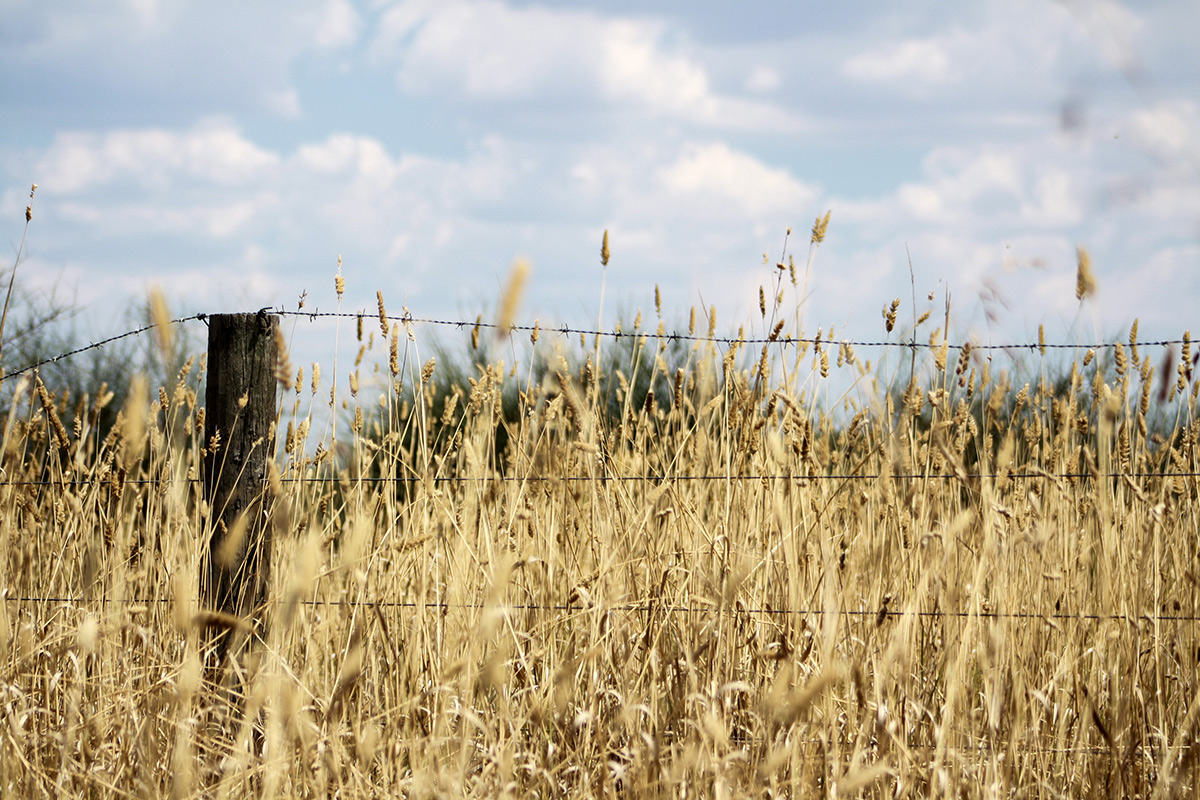
When low rainfall and extreme heat / high evaporation combine, they can rapidly dry the Australian landscape. This is called Flash Drought. Last summer’s flash drought brought rapid curing of grasslands, and ultimately fires when high winds and in some places dry lightning occurred at the end of the Victorian heatwave on 9 January. By the end of January, one person had died, and 451 homes and around 1,100 other buildings were reported destroyed by fire in Victoria and nearly 450,000 hectares were burnt and 45,000 livestock died (Parliament of Victoria 2026). Despite La Niña in 2025-26, which historically meant cooler and wetter summer conditions, the rapid drying of the landscape from intense heatwaves brought about the biggest losses to fire in Victoria since the Black Summer.
Flash drought can take a landscape from lush to tinderbox in as little as 3–4 weeks — leaving farmers and communities with little time to prepare. Flash drought isn’t just a lack of rain; extreme heat draws moisture from soil and plants far faster than rainfall deficits alone.
Green drought creates a false sense of security: surface grass looks green after recent rain, but deep subsoil moisture is very dry. When a heatwave hits, that green cover rapidly turns to fuel.
Fire weather that’s more dangerous, arrives earlier and lasts longer
Climate pollution is the key driver of worsening fire seasons, and El Niño adds fuel by heating and drying the landscape. Hotter, drier conditions mean fire seasons are expanding at both ends — starting earlier, finishing later, and burning more intensely when they do ignite.
Fire seasons across Australia have lengthened by 20% since the 1970s (Climate Council 2026). After Black Saturday in 2009, Australia introduced a new top-tier fire danger rating of ‘Catastrophic’ because previous scales were no longer adequate for worsening fire conditions intensified by climate pollution (Hollis et al. 2024).
The years following an El Niño have historically been when major fires have occurred in Australia. When the Black Summer fires started in 2019 it was not an El Niño year, but followed the 2015-2016 El Niño that helped dry out south-eastern Australia. There are already concerns about what the 2027 – 2028 bushfire season might deliver if there is no return to La Niña.
Deadly extreme heat
Australia, on average, has warmed by 1.59°C since national records began in 1910. The baseline has shifted. So when extremes now strike, they strike from a hotter, more dangerous starting point.
Heatwaves are the deadliest climate disaster. Extreme heat causes around 10 times more hospitalisations than any other extreme weather event. Emergency department visits for heat-related illness rise more than 20% for every 1°C increase in maximum daily temperature during summer (NSW Net Zero Commission 2026).
Sydney’s summer now starts almost a month earlier and lasts twice as long as it did in the 1960s (Scott et al, 2026).
Marine heatwaves and coral bleaching
Warmer oceans are a direct consequence of climate pollution — our oceans absorb more than 90% of the excess heat trapped by fossil fuel pollution. El Niño amplifies this, raising sea surface temperatures further. On 22 August 2026, the daily global average sea surface temperature reached 21.1℃, the hottest global ocean temperature ever recorded (Copernicus 2026). The timing of the new record is remarkable because global ocean temperatures usually peak in March and April at the end of summer in the Southern Hemisphere (which is mostly ocean). Watch out for more ocean temperature records in 2027 and marine heatwaves that cause coral bleaching and damage to marine life.
The Great Barrier Reef has experienced six mass bleaching events in a decade (AIMS 2025). Marine heatwaves have doubled in frequency since the 1980s. Before 1998, there had never been a mass coral bleaching event on the Great Barrier Reef.
WHAT ABOUT THE REST OF THE WORLD?
The most obvious impacts are usually felt in places closest to the unusually warm Pacific waters. Some typical El Niño impacts outside Australia include:
- Hot and dry weather in Indonesia, India and parts of southern Asia and the Southwest Pacific, as rainfall shifts away from these areas and towards South America.
- Increased rainfall in other parts of the world, including southern South America, western and southern United States, the Horn of Africa, central Pacific nations and central Asia.
- More marine heatwaves and mass coral bleaching events in tropical waters around the world.
What drove the record heat and fires in Europe?
El Niño did not influence the 2026 European summer.
Climate pollution from the burning of coal, oil and gas drove the hottest June and July ever recorded in Europe, resulting in a series of heatwaves, severe flash drought and major fires. Studies show Europe’s June heatwaves were virtually impossible without climate pollution and global heating made the hot, windy fire conditions 20 times more likely in Spain.
COSTS THAT FAMILIES ARE ALREADY PAYING
Climate-fuelled disasters are factored into today’s insurance premiums, disaster recovery costs and rising food prices. Australians pay the second highest disaster costs in the world after the US. Polluters are getting a free ride while families pay the costs.
- Extreme weather costs Australians three times more than in the 1990s (ICA 2024).
- Disasters already cost Australia $38 billion a year — projected to reach $73 billion by 2060 without stronger climate pollution cuts (Deloitte Access Economics 2021).
- Insurance premiums in fire-prone areas are up 78–138% since 2020 (Climate Council & ELCA 2025). In 2025, Australians paid up to $700 more for home and contents insurance premiums than the year before.
- The 2019–20 Black Summer wiped up to $4.6 billion from Gross Domestic Production (GDP) and caused $2.4 billion in insurance losses (Climate Council 2026).
- Per-person economic losses in Australia from disasters have risen 222% since the 1980s — from $60 per person to $193 per person per year (Climate Council 2026)