We can’t sugarcoat it – there’s a lot of bad news around and it can be hard to find hope, especially when climate news can be confronting.
But there was good news too. Changing the world is a big lift, and slowly but surely we are turning this enormous ship around – thanks to the tireless efforts of many individuals, communities, businesses and governments.
Here are some of the biggest climate news stories this year that give us hope.
The seven biggest climate stories from Australia
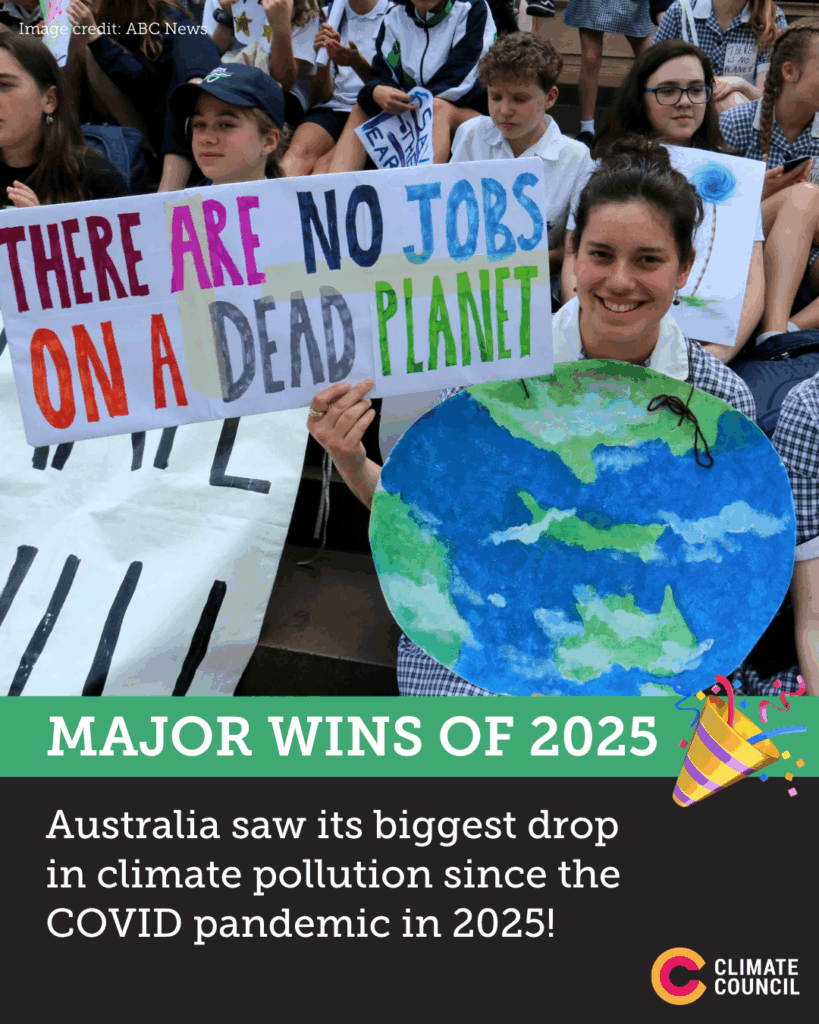
- Biggest annual drop in climate pollution outside COVID. Greenhouse gas emissions fell by 2.2% in the year to June 2025, driven by a surge in renewable energy replacing coal and gas.
- For the first time, renewable energy overtook fossil fuels to power Australia’s main energy market. Clean energy in the National Energy Market (including every state and territory except Western Australia and Northern Territory), supplied a record 51% of electricity in October (and even went as high as 79% at one point on 11 October).
- The new national battery rebate powered into action. In only six months the scheme has almost doubled Australia’s home battery capacity, and is on track to have helped 175,000 households and small businesses cut their power bills by the end of December. It’s now being expanded to help install two million household batteries by 2030.

- Australia finally caught up with most of the world by implementing vehicle fuel efficiency standards – i.e stopping the most polluting cars from entering our market. These cleaner standards kicked into gear at the start of the year and will prevent 20 million tonnes of climate pollution by 2030. Meanwhile, the share of electric vehicles among new car sales in Australia has accelerated from 0.8% in 2020 to 12% in 2025.
- Australia announced a new climate target (a commitment most countries have made to cooperate in cutting global pollution). The government has committed to cut pollution by 62-70% by 2035. To help achieve our new target, the government announced new programs to increase renewable generation, help industry decarbonise, roll out more EV chargers, and more.
- Australia’s nature laws have been strengthened for the first time in half a century. Thanks to a deal with the Greens, the new laws will strengthen protection for native forests and accelerate environmentally responsible renewable power.
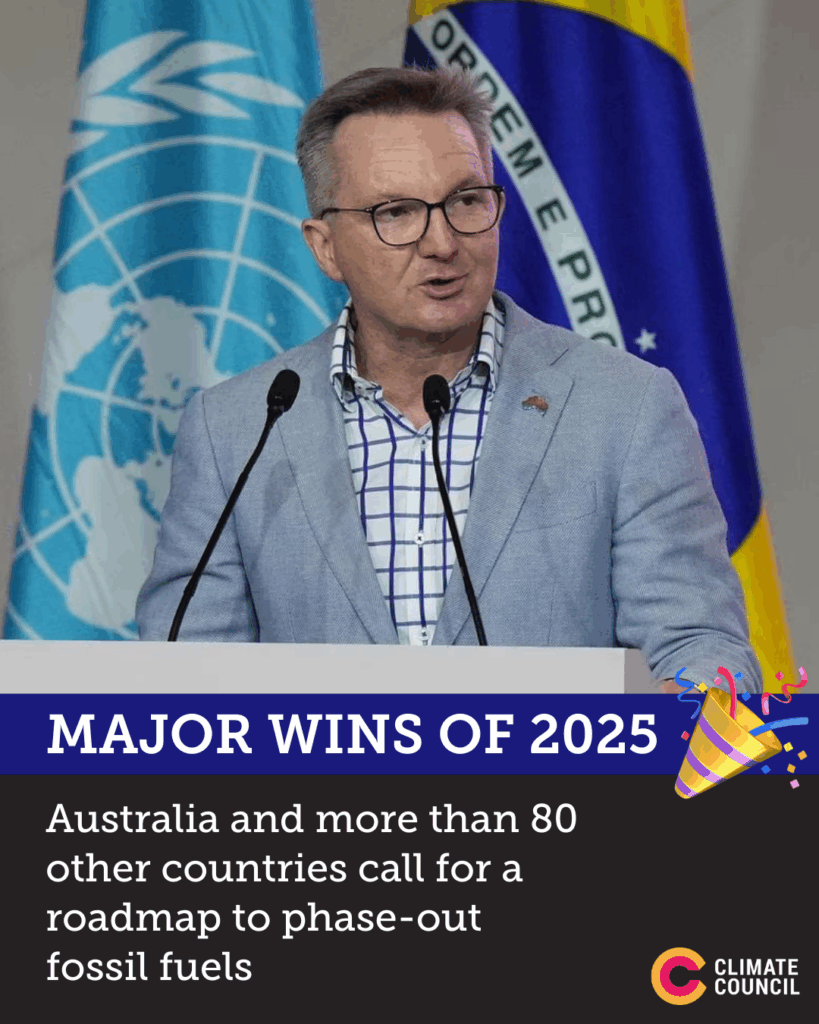
- We didn’t win the bid to host the world’s largest climate conference (COP31) next year, but we did join a growing list of countries signing up to a roadmap to phase out fossil fuels. It’s the strongest language we’ve seen from the Australian Government yet about the need to switch away from fossil fuels.
The five biggest climate stories from around the world
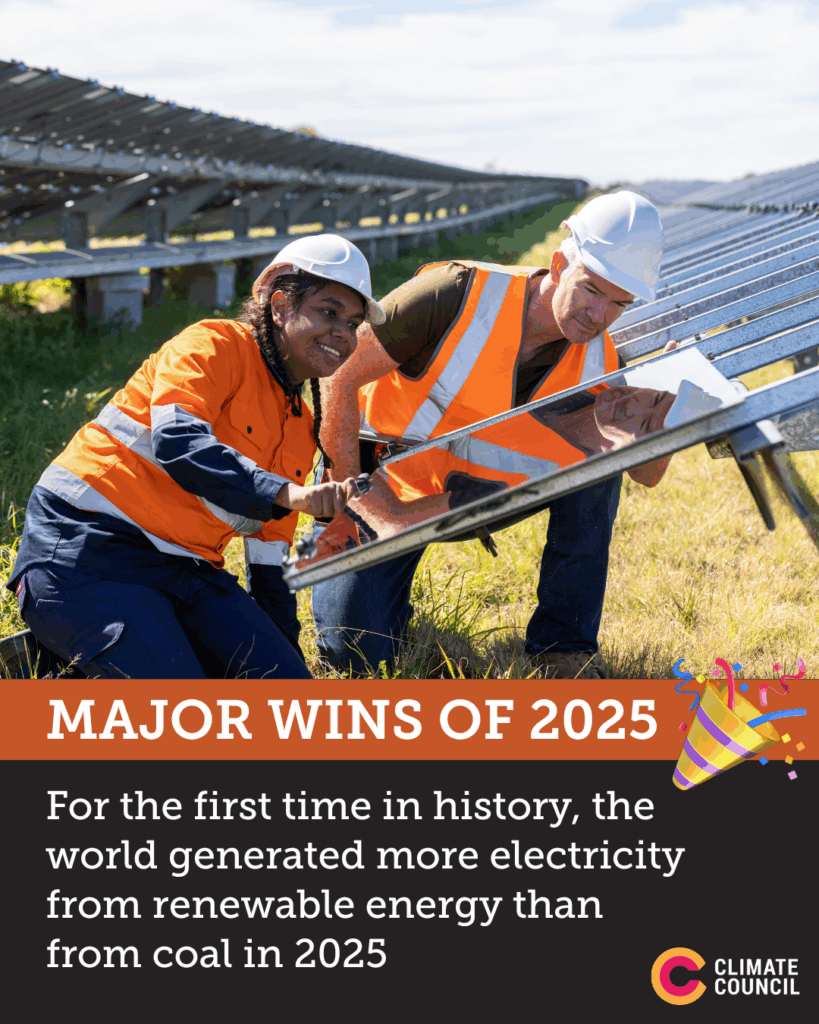
- For the first time, renewables provided more of the world electricity than coal, marking a turning point for the global power system. Solar and wind are now growing fast enough to meet the world’s growing appetite for electricity, and so clean power is keeping pace with demand growth.
- In a landmark case in July, the International Court of Justice ruled that all countries have a legal obligation to protect and prevent harm to the climate and can be held liable for climate change damage. While the court’s advisory opinions are non-binding, they can still have a powerful impact, both legally and politically.
- China’s carbon emissions have been flat or falling for the past 18 months, indicating the world’s largest greenhouse gas emitter may reach peak emissions earlier than anticipated. This is attributed to China’s rapid increase in solar and wind generation, even with increasing demand for electricity.
There was twice as much investment in renewable energy compared to fossil fuels. Globally, there is more investment than solar than there is in any other type of energy technology. - South Korea has committed to phasing out most of its coal fired power plants by 2040. It operates the seventh largest coal fleet in the world but the share of coal generation has decreased from 42.5 per cent in 2015 to 30.5 per cent in 2024. As one the world’s top coal importers, and one of Australia’s largest coal customers, this signals a major shift for the industry.


And that’s just the shortlist!
We’re looking forward to more good news in 2026.