
The escalating conflict in Iran and neighbouring countries is a significant risk to Australian households. Around one fifth of the world’s oil and gas flows through the Strait of Hormuz. Markets are already reacting and fuel prices are rising here. When fossil fuel supply is threatened, prices spike and Australians pay.
We experienced this after Russia invaded Ukraine in 2022. Petrol prices surged. Electricity bills jumped by around $400 a year on average. Gas exporters made windfall profits while households struggled.
This is Australia’s core energy vulnerability: we are still deeply exposed to volatile global fossil fuel markets. As long as our power system and transport rely on coal, oil and gas, overseas conflicts will cause price shocks.
The only durable protection is to reduce our dependence by accelerating renewable energy and the electrification of homes, businesses and transport. This delivers lasting cost-of-living protection and energy security, while cutting climate pollution.
Key Insights
- Our dependence on oil and gas is a risk to our climate, energy security and cost-of-living.
- For decades, global conflicts in fossil fuel producing regions have led to price shocks and prompted debate on energy security.
- For example, around one fifth of the world’s oil and gas flows through the Strait of Hormuz between Iran and Oman. This means any disruption in the region threatens higher petrol and electricity prices here and around the world.
- Australians have already paid a high price for overseas fossil fuel shocks.
- After Russia invaded Ukraine in 2022, average Australian electricity bills jumped by around $400 a year as global gas prices surged, while petrol prices also soared.
- Australia is still highly exposed to global fossil fuel price spikes.
- We import more than 90% of our refined fuel and export more than 80% of our gas, tying local prices for households and businesses to volatile global markets.
- Clean energy and electrification are already cutting bills and shielding our households from price shocks.
- Renewables and storage now provide nearly 45% of electricity in Australia’s main grid and helped cut wholesale power prices almost in half in late 2025 – reducing our reliance on gas that drives price spikes.
- Switching from gas to efficient electric appliances can save households between $500 and $1,900 every year; and insulates families from volatile gas prices.
- EV drivers save around $1,400 a year in fuel and maintenance compared to petrol cars, and are far less exposed to global oil price spikes.
- To protect households, governments should accelerate the roll out of renewable energy, storage and electrification.
- Power prices are projected to fall by 5% over the next five years as more renewables come online.
- Electrification of our homes and transport reduces reliance on imported oil and gas, cutting costs and shielding households from future global price shocks.
- Now is the time to double down on policies to accelerate the renewable rollout and make the benefits of rooftop solar, storage and electrification more accessible.
Global conflict exposes Australians to higher prices
Around one fifth of the world’s oil and fossil gas is shipped through the Strait of Hormuz, between Iran and Oman. The Strait is now effectively closed, significantly disrupting global fuel supplies.
Oil supply constraints drive up petrol prices
Australia imports more than 90% of our refined oil products, like petrol and diesel, leaving us highly exposed to global oil supply disruptions and price shocks. Our national fuel reserves sit at 36 days worth – well below the international benchmark of 90 days.
Following Russia’s invasion of Ukraine, oil prices surged – prompting the Australian Government to temporarily cut the fuel excise drivers pay on their petrol in half – from 44 cents to 22 cents. This saved Australians, at a cost to the Government of $5.6 billion in lost revenue over six months. Even with the excise cut, retail petrol prices were $188c/litre in the September 2022 quarter, their highest in real terms since 2008.
If conflict in and around Iran continues to constrain oil supplies, some economists expect petrol prices to rise by between 25 cents and $1 a litre, depending on the level of disruption – adding between around $9 and $35 a week for an average household. Analysis by NRMA shows that petrol stations in Sydney, Melbourne and Brisbane are already hiking their prices – with half the service stations in these cities charging almost $2.20 a litre for regular unleaded.
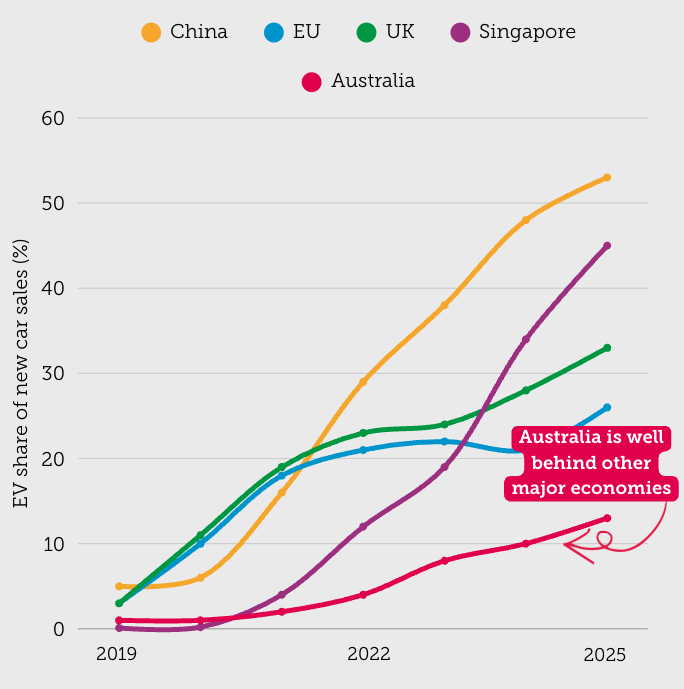
While EV sales in Australia are picking up, we are still lagging behind the developed world. With around 98% of Australian cars still relying on petrol or diesel, most households will be significantly exposed.
Figure 1: MOST AUSTRALIANS ARE EXPOSED TO RISING FUEL PRICES, AS EV SALES IN AUSTRALIA ARE STILL LAGGING GLOBALLY
Gas prices drive power bill pain
Following recent attacks, Qatar – which provides nearly 20% of the world’s gas – has stopped its gas production. Wholesale gas prices have jumped by 50% in Europe and almost 40% in Asia. So far, there is no evidence that the conflict is pushing up Australian gas prices – but there is significant risk of this occurring.
Australia produces more than enough gas to power our homes and businesses for decades to come, but we remain impacted by these global events because we export the vast majority (more than 80%) of our gas overseas.
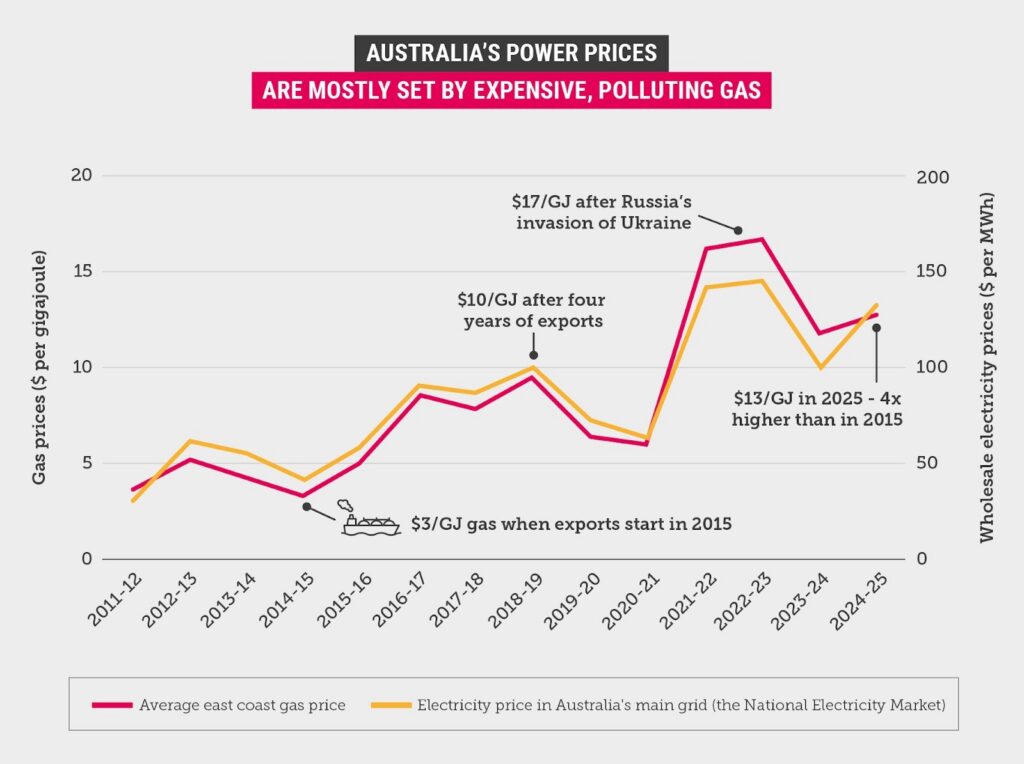
Before we started exporting gas from the east coast in 2015, gas prices had been consistently around $3-5 per gigajoule (GJ). In the months following Russia’s invasion of Ukraine, east coast gas prices surged as high as $30-40/GJ. Today they remain around $13-15/GJ – four times higher than they were a decade ago.
When gas prices rise, electricity prices follow. Soaring gas prices have played a major role in the tripling of wholesale power prices (which make up around 40% of our bills) over the past decade. This has a big impact on household power bills which jumped by about $400 (on average) following the invasion of Ukraine.
Cleaning up transport strengthens our energy security and saves us money
Reducing our reliance on petrol and diesel vehicles strengthens energy security by reducing reliance on imported oil, and shielding households from geopolitical shocks that can send petrol prices soaring. Charging a car with electricity is significantly cheaper than using fuel, and electric vehicles (EVs) have fewer moving parts, which lowers maintenance and servicing expenses over time.
People with EVs spend 40% less on annual vehicle running costs, or save around $1,400 per year on fuel and maintenance costs.
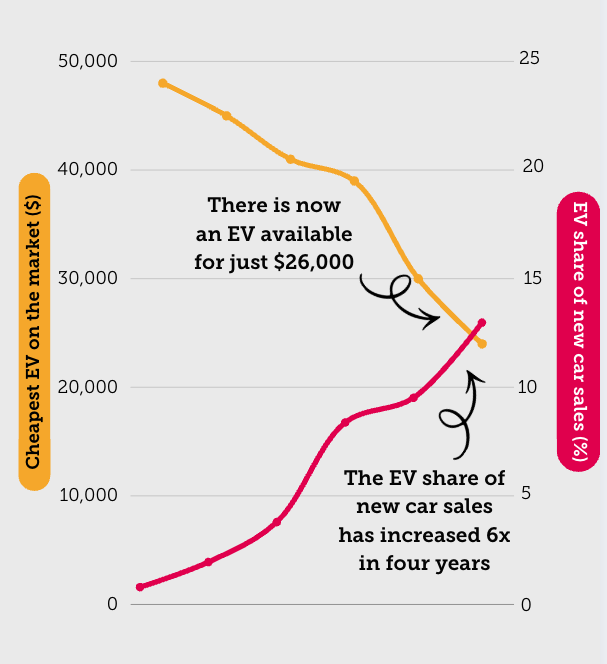
EVs sales in Australia are rising rapidly – from just 0.8% of new car sales in 2020 to more than 13% today. There are now twice as many EVs on our roads (454,000) than there were two years ago.
This has been driven by federal policy: with the introduction of the electric car tax discount in 2022 and the new vehicle fuel efficiency standards (NVES) in 2025, as well as significant investment in charging infrastructure and supportive state measures.
Australians now have more choice than ever when it comes to going electric with more than 150 EV models (including utes, and models priced as low as $26,000) available in Australia compared to only 28 models five years ago.
Cars are just one small part of an economy still heavily reliant on oil. To protect our economy from rising oil costs we need to reduce fossil fuel use across the system wherever we can – in heavy vehicles, ships, planes and in the machinery many of our industries, like mining and agriculture, rely on.
EV SALES ARE RISING WITH MORE ACCESS AND CHOICE
Clean energy puts the power back in our hands
Renewables, batteries and electrification are not only climate solutions, they are also energy security solutions.
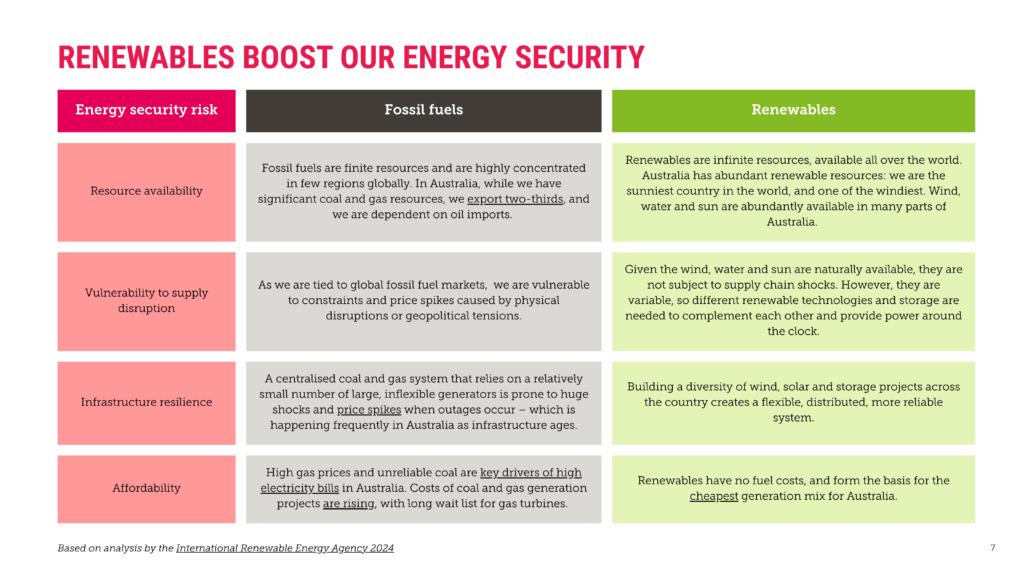
Unlike fossil fuels, solar and wind are freely available and abundant local resources that aren’t traded on volatile global markets. They are far cheaper to build, and also stable and low-cost to operate. Backed by storage like batteries and pumped hydro, renewables can power our homes, industry and businesses around the clock. Any transmission needed to connect renewable energy is expected to deliver net savings to homes and businesses.
The renewables in our grid lowered average household electricity bills by up to $417 in 2024 by reducing our reliance on coal and gas. Today, renewables and storage now provide nearly 45% of electricity in Australia’s main grid (on average), and is growing rapidly. In the last three months of 2025, they provided more than half our power for the first time, cutting wholesale power prices almost in half. Power prices are tipped to fall by 5% over the next five years as we roll out more renewables.
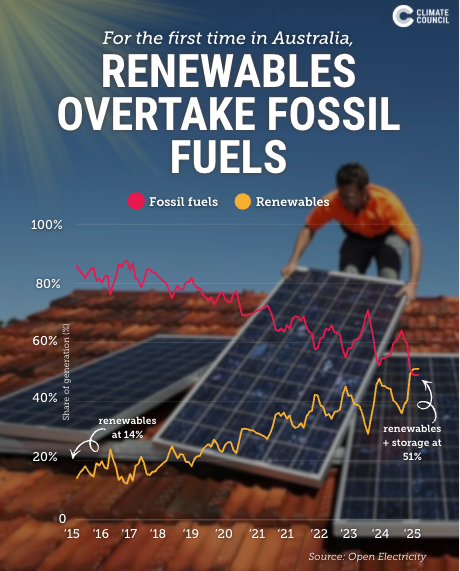
CLEAN ENERGY CAN PROVIDE IMMEDIATE COST RELIEF
Powering our homes and businesses with clean, affordable energy and reducing our reliance on energy retailers is a win for the climate, and a win for our wallets.
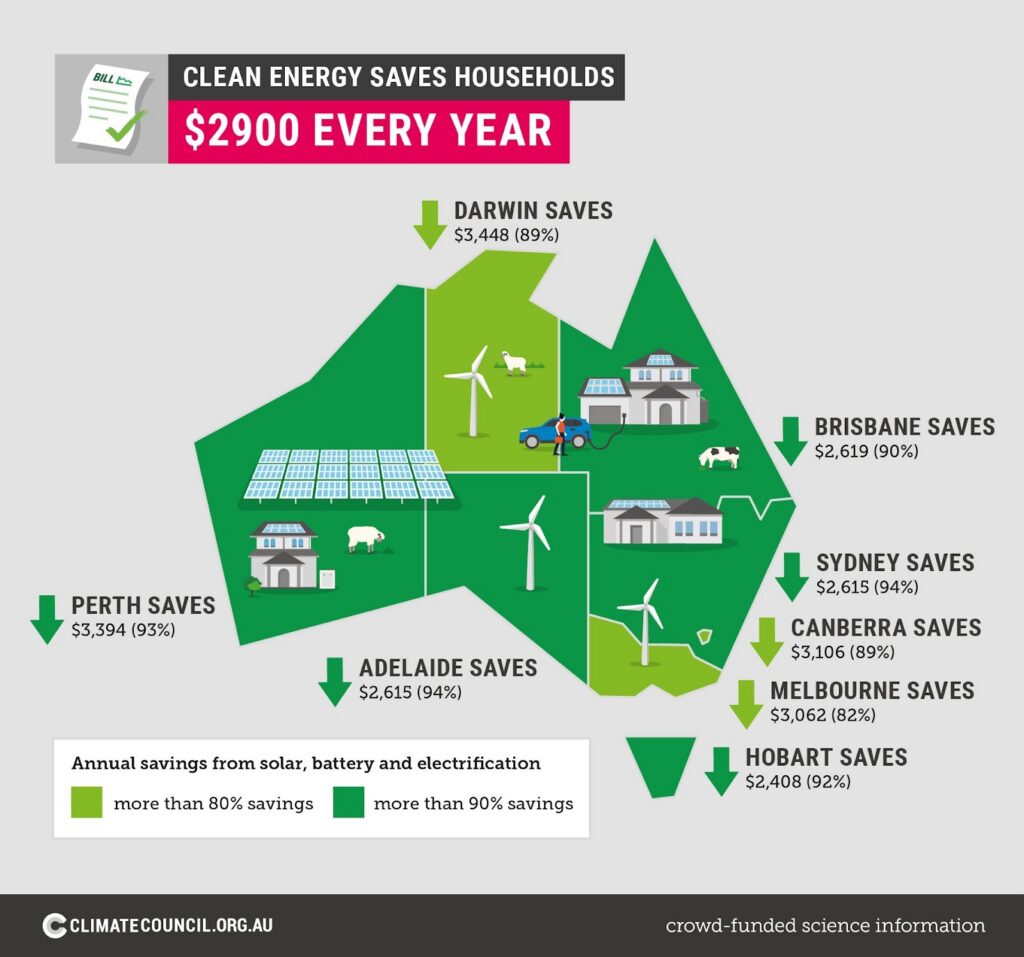
Switching from gas to efficient electric appliances (like heaters, hot water systems and cooking appliances) can save households between $500 and $1,900 every year. Combined with rooftop solar storage, this can slash total energy bills by around 90%, and directly and immediately shield households from future price shocks.
While costs of solar and batteries are falling, and government support is making the technologies accessible to more Australians, these game-changing upgrades are still out of reach for some. Renters, people in apartments, and low-income households face significant barriers. With smart policies and leadership, governments can ensure more Australians can directly access the benefits of electrification, solar and batteries more swiftly.
The lesson from global conflicts like Ukraine and Iran
Since at least the 1970s, global conflicts that break out in fossil fuel producing regions have led to price shocks, and prompted debate on energy security. The conflict in Iran provides more impetus for governments to double down on policies that clean up our grid and our transport system. Any delay threatens to increase Australians’ energy bills: a one-year delay in wind or transmission projects could increase residential power prices by up to 20%.
Of course, if we accelerate the rollout of clean power and transport then we will keep bills as low as possible, all while boosting energy security and cutting climate pollution. Renewables and electrification are powering ahead, but the switch to cleaner, cheaper technologies and all their benefits are not yet guaranteed. Now is the time to double down on policies to boost their uptake.
For example, right now, the Australian Government is reviewing the EV tax discount it introduced in 2022. Over the past three years, the Electric Car Discount and other key policies have helped drive EV uptake in Australia, with sales rising from just 2% of new car sales in 2021 to 13% in 2025. Similarly, the Cheaper Home Batteries Scheme has significantly boosted uptake: nearly as many home batteries were installed in the second half of 2025 as during the previous four years combined. It is critical that policies like these that help us get off polluting fossil fuels and cut costs are retained, while policies that subsidise the use of polluting fossil fuels are phased out.
Accelerating the rollout of a renewable grid and other clean technologies, including EVs, is the most effective way to lower energy bills, protect households and cut climate pollution at the same time. Delaying this would only lock in higher costs, risk energy security and put more pressure on households already doing it tough.