The experts at Australia’s leading energy and science bodies, including the Australian Energy Regulator, Australian Energy Market Operator (AEMO), Australian Energy Market Commission and CSIRO, have crunched the numbers to determine the best, cheapest form of electricity for Australia. Their analysis consistently shows that renewable power, backed by storage like pumped hydro and batteries, is the most cost-effective way to keep reliably powering Australian homes and businesses.
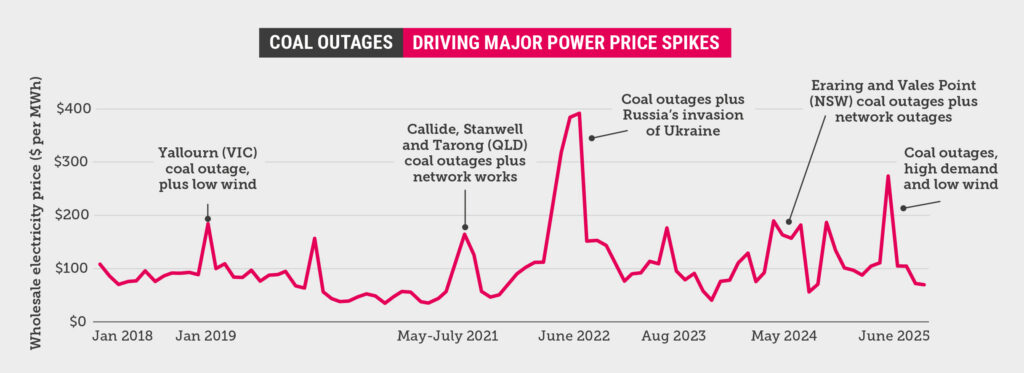
Already, nearly 45% of Australia’s electricity comes from solar, wind, hydro power and batteries – and this is rapidly increasing. At the same time, the share of fossil fuels in our grid is falling. As Australia’s coal-fired power stations age they are only operating at around 65% of their full capacit and are frequently breaking down. Coal outages have been a primary driver of power outage warnings in recent years, as well as contributing to some of the most severe price spikes. Australia’s energy market operator is preparing for two-thirds of the remaining coal fleet to close by 2035, with all due to retire by 2049.
As coal generators reach their end-of-life, there is no question that we must bring new generation online to power our homes and businesses. But what is the most cost-effective way to reliably power our homes and businesses past the end of coal?
The clear answer is: renewables and storage.
How much do renewable energy projects cost?
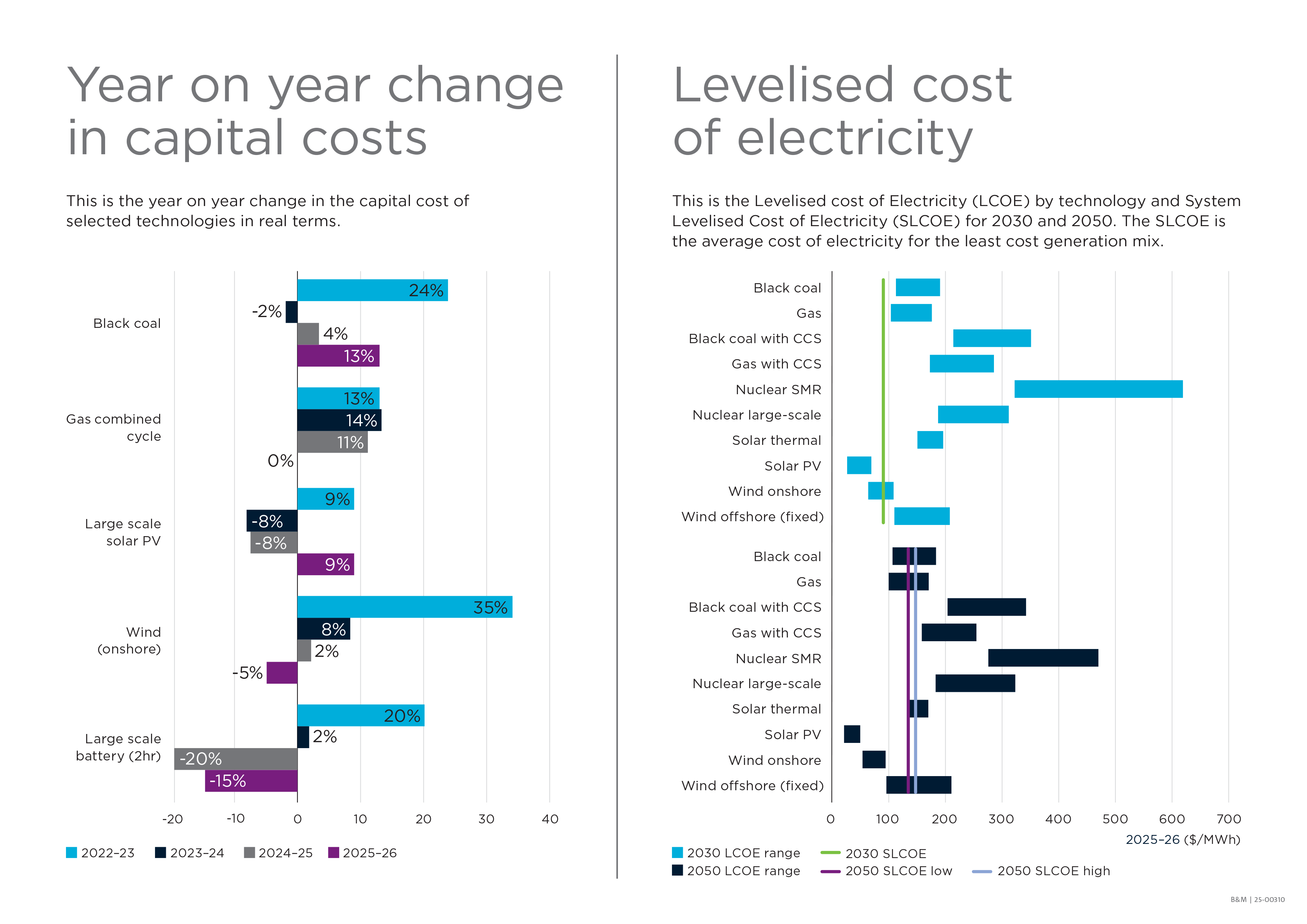
CSIRO’s draft 2025-26 GenCost Report found for the eighth year in a row that a renewable power system is the lowest-cost option for Australia. Solar is by far the lowest-cost technology, onshore wind is cheaper than coal and gas, and battery costs are continuing to fall. Both can be rapidly deployed. Meanwhile, the costs of coal and gas generation projects have increased significantly, and waiting lists for new gas turbines have blown out into the 2030s. Large-scale nuclear costs three times as much as a wind project (per kilowatt-hour) while small-scale nuclear would cost nine times as much.
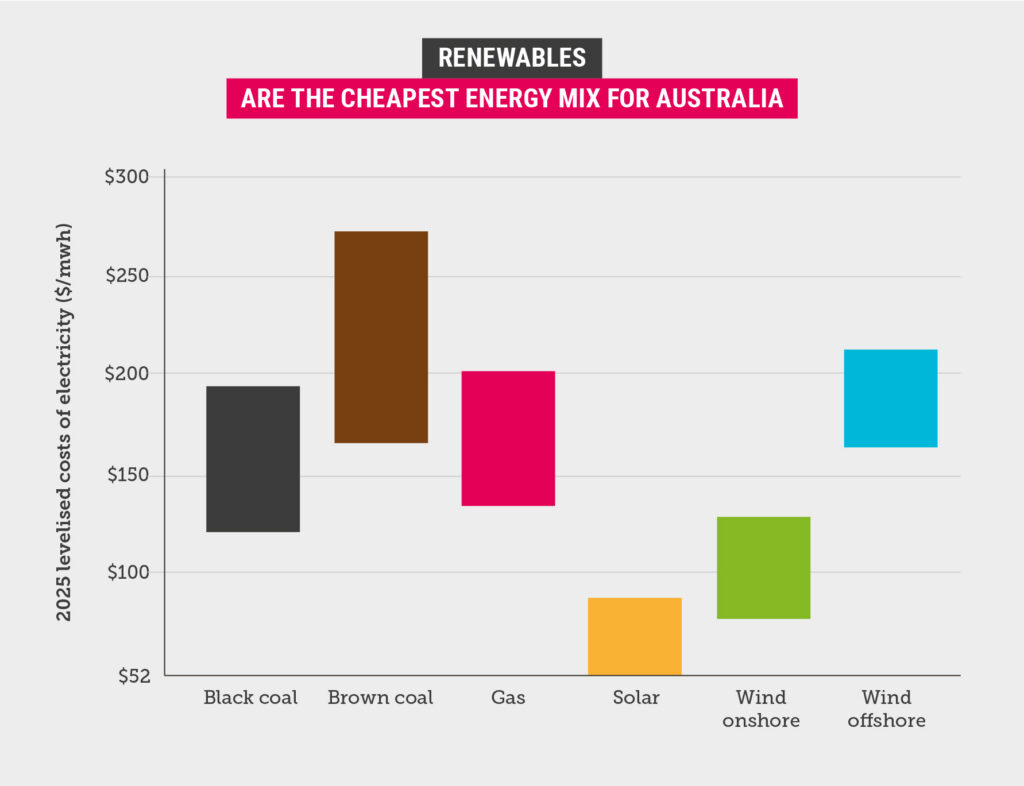
How much does power from renewables cost compared to power from fossil fuels?
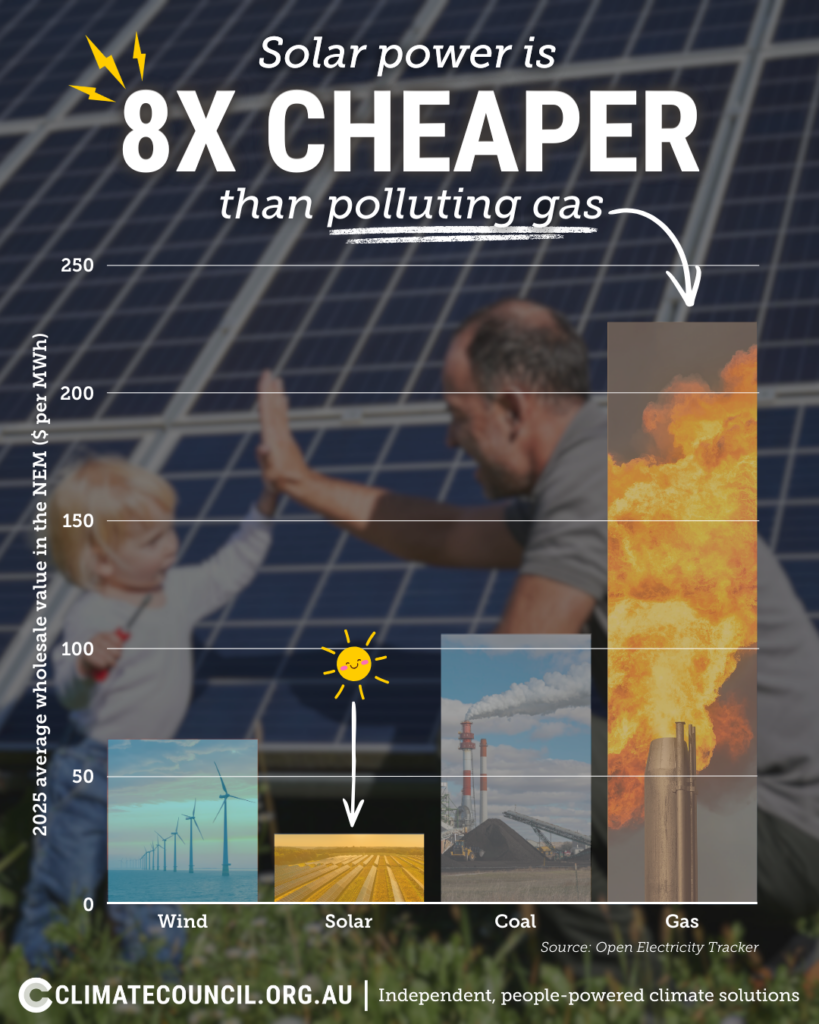
Renewables are both the cheapest energy projects, and by far the cheapest source of power throughout their lifetimes. This is because unlike fossil fuels, Australia’s abundant wind and sun are infinite, freely available resources. In contrast, coal and gas-fired power stations pay international prices for these fossil fuels, which are subject to international price shocks caused by volatility in the coal, oil and gas markets.
On average in 25, the wholesale price for power from renewables (the price electricity retailers pay, which accounts for up to 40% of our power bills) was $59/MWh – compared to $115/MWh for power from coal and gas.
Learn more in our report Power Games: Who’s driving high power bills?
Wouldn’t it be cheaper and easier to keep our coal stations open?
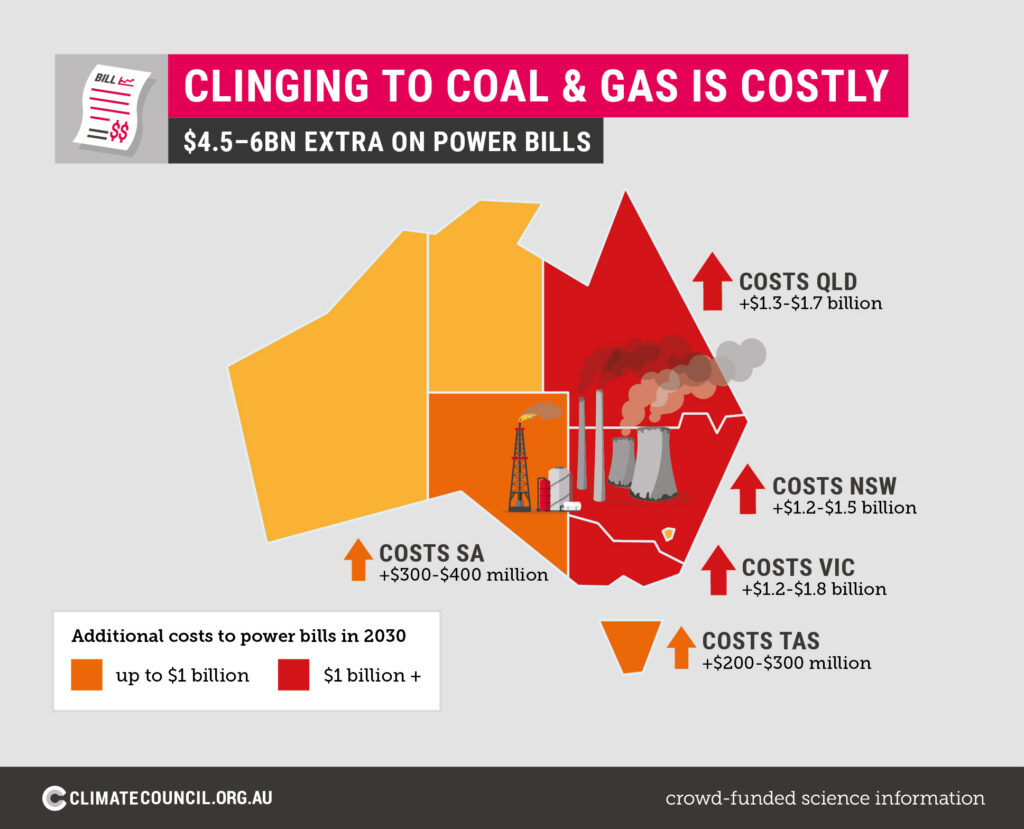
Keeping existing coal power stations running would be an extremely costly and, at best, temporary solution. Over the next five years, the Queensland Government will spend at least $1.6 billion to maintain its existing coal generators. Eraring coal power station in NSW – which will now be kept open until 2029 despite significant outages in recent years – costs up to $250 million every year in maintenance. Despite investment of $40 million to improve its reliability, Vales Point in NSW has had several recent unplanned outages, including an outage on 10 February 2026 which triggered warnings from the market operator of supply constraints and price spikes.
If we continued our reliance on coal and gas rather than building more renewables, power bills would increase by up to $606 a year for households, and $1,182 for a small business this decade, all because of the continued reliance on coal and additional gas generation.
What about the costs of new transmission needed to connect us to renewables?
Unlike the historic investment in our distribution networks, the transmission projects underway or planned in Australia’s main grid would deliver net savings to consumers of $24 billion by 2050 – compared to a scenario where we don’t build new transmission – because they are connecting us to cheap, clean energy. However, keeping network costs as low as possible – including the costs of new transmission – is critical to keeping power bills in check.
Batteries can boost the capacity of our existing networks and reduce the need for new transmission. Charging batteries with cheap electricity during the day, when solar power generation is at its peak, can reduce issues with network congestion. This is known as “virtual transmission”. With battery prices falling (big battery costs dropped 20% in 2024-25 alone), more batteries in strategic locations will help reduce the amount of transmission needed and keep network costs as low as possible. In its latest roadmap for Australia’s energy system, the Australian Energy Market Operator expects the surge of grid-scale batteries to reduce the amount of new transmission we need by 40%.
Why are my power bills still so high if the share of renewables in our grid is increasing?
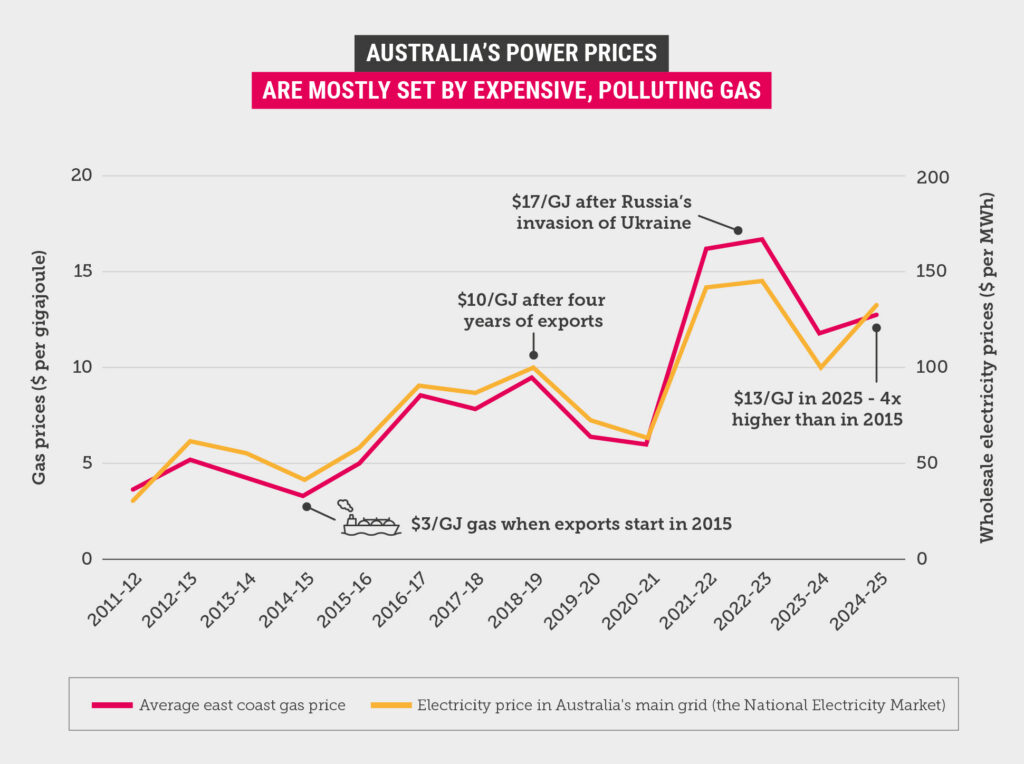
Although Australia now has a more than 40% renewable grid, we still rely on expensive, polluting coal and gas for more than half of our power – pushing up power bills. Gas is often the most expensive source of energy in the market today, with high international prices for this fossil fuel playing a big part in driving up household power bills over the past few years. Even though only about 5% of power in Australia’s main grid comes from gas, research from Griffith University shows that because gas is so expensive, gas prices drive 50-90% of pricing periods in the National Electricity Market.
Outages in our decrepit coal clunkers have also contributed to some of the most severe price spikes in recent years – fossil fuel companies take advantage of reduced energy capacity when these outages occur and jack up their prices to maximise profits. For example, in late 2024, coal-fired generators recorded all-time low availability due to planned and unplanned outages. This contributed to higher power prices and several extreme price spikes in New South Wales and Queensland.
Are renewables a reliable source of power?
Not only are renewables the cheapest option, they are the best way to reliably power our homes and businesses into the future. AEMO has found that large-scale solar and wind, backed up by storage (batteries and pumped hydro), can provide power to Australians 24/7. Different types of renewable energy, like wind and solar, complement each other to provide power around the clock. A combination of household, community and big batteries and pumped hydro can store excess power when it’s available, and make it available later on when we need it. The good news is, battery prices are falling fast: since 2013, global battery prices have plunged by 86%.
Find out more about the important role of batteries in our grid in the Climate Council’s report Battery Boom: Supercharging Australia’s Renewable Rollout.
How do renewable power projects support Australia’s economy?
Renewable projects bring wide-ranging economic and social benefits to Australia. They are attracting huge amounts of private investment into our economy: renewable projects will inject $68 billion into Australia’s economy over the next five years, and are expected to put $1.3 billion directly into the pockets of farmers and regional communities by 2030 through landholder payments and community benefit sharing funds.
Already, more than 250,000 Australians are powering Australia’s shift to renewables in generation, demand and enabling roles. Around 21,500 Australians directly work in wind, solar, storage and transmission projects in Australia’s main grid, and even more in WA and the NT. Women make up nearly 40% of our renewable workforce – compared to just 23% of the fossil fuel workforce. The shift to renewables will create 33,000 new jobs at its peak in 2029, doubling the current size of the energy workforce. On average between now and 2050, we will need an energy workforce of 52,900.
Projects across Australia are also developing innovative ways to help local communities thrive: from workforce diversity initiatives, supporting farmers and their livestock, and supporting local schools, sports clubs and community groups. Work is also underway to ensure First Nations communities are empowered to share in the economic benefits, job opportunities and access to lower-cost and reliable power.
Read about 11 inspiring renewables projects giving back to communities around Australia in meaningful ways.
In this critical decade for climate action, we can’t afford not to roll out more affordable, reliable renewables
The falling costs of renewable energy and clean technologies are driving down the costs of reducing climate pollution. At the same time, we are already feeling the growing economic costs of inaction on climate change. 2025 was the third hottest year on record, and that the past 11 years have been the 11 hottest years ever documented.
Climate pollution is endangering our homes, and risking the biggest asset of many Australians. Flood risk has already put a $42.2 billion dent in property values.The cost of cutting climate pollution is dramatically less than the cost of unchecked climate change, which would cost Australia $4.2 trillion in today’s dollars by 2070.
With the increasing affordability and availability of clean energy technologies, Australia must take strong action to build a renewable, reliable, affordable grid and get off coal, oil and gas as soon as possible – cutting climate pollution, putting downward pressure on power bills, bringing economic and social benefits, and building a safer future for our kids.

support climate action
Trusted. Independent. Influential.
The Climate Council is 100% independent and funded entirely by our community. That means we speak to the facts, the evidence and the science without government or corporate influence.