
With petrol hitting $2.53 a litre and diesel crossing the $3 mark, Australians have been feeling the cost of fossil fuel dependence at the bowser. In March 2026, Australian motorists paid more than $1 billion above what they’d normally spend at the bowser.
So how do we better protect Australians from global fuel shocks and energy price pain? While some call for drilling more Australian oil, the data shows that new wells are too slow and too expensive to address fuel shortages and price spikes now – or within the next decade. Here’s why:
1. Australia’s oil reserves are practically exhausted
Australia once had significant crude oil reserves. We’ve used almost all of them.
More than 90% of our conventional crude oil resources have been extracted. What remains – in proven, commercially viable reserves – would meet Australia’s fuel needs for less than seven months. Oil has always been a finite resource, and now Australia is facing the tail-end of its reserves as supplies run out.
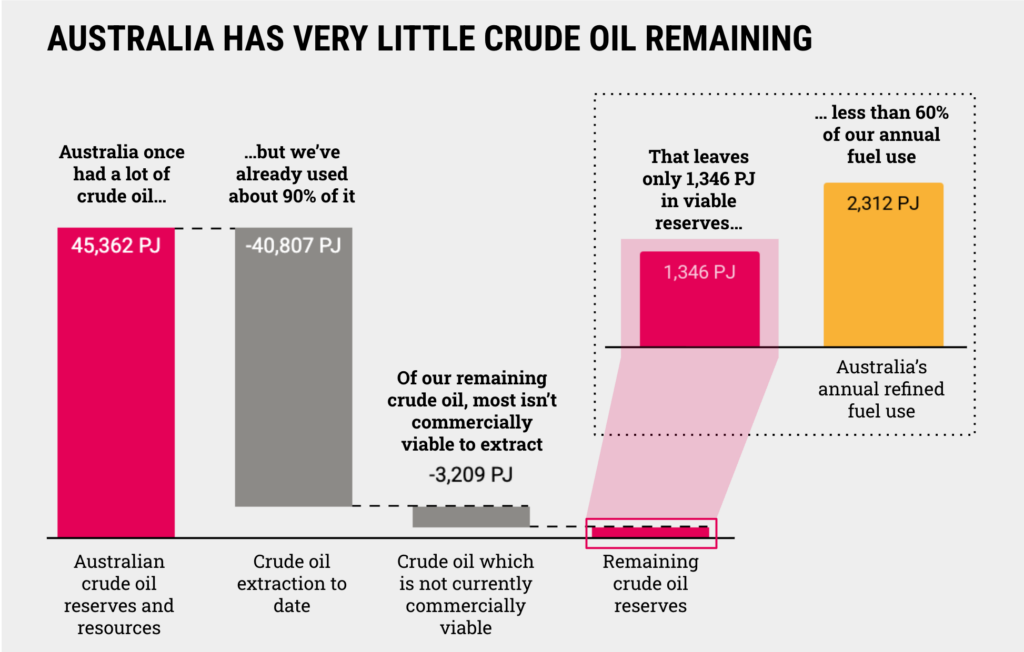
Australia’s oil production trajectory reflects this reality. Extraction has been declining for more than 25 years – not because of green tape, but because our conventional oil basins have been exhausted. Meanwhile, gas extraction quadrupled over the same period. Oil’s decline has nothing to do with regulation, and everything to do with geology and economics – oil just doesn’t stack up in Australia anymore.
There isn’t enough Australian oil left to meaningfully change our situation at the pump.
2. Digging for more oil would be expensive, slow, and harmful
Australia’s remaining oil resources, such as the Taroom Trough, are largely speculative “tight oil,” requiring fracking to extract. Developing and extracting that oil is complex and expensive, which is why it has not already occurred.
A new oil field takes roughly a decade to go from discovery to production. Even if approvals are fast-tracked, a new oil development is unlikely to make a dent in Australia’s oil extraction this decade. It offers no relief to households or small businesses paying hundreds to fill a tank this week, this year, or even this decade.
Extracting “tight oil” also requires hydraulic fracturing, or “fracking”. This means drilling 3-4km underground, drilling horizontally, and then pumping in water, sand and chemicals to break the rock and extract oil. This process is complex and expensive, uses large amounts of water, and poses significant environmental and health risks – including cancer.
3. Australian oil refineries don’t stack up against overseas competition
It’s widely known that since most of our refineries closed, the majority of Australia’s fuel has been imported – including 64% of our petrol, and 85% of our diesel as of 2024.
What’s less known is that even the small amount of fuel that is still refined in Australia mostly comes from imported oil. Australian refineries have imported the majority of their oil for over 30 years (since 1993), and now over 95% of the oil used by our refineries comes from overseas.
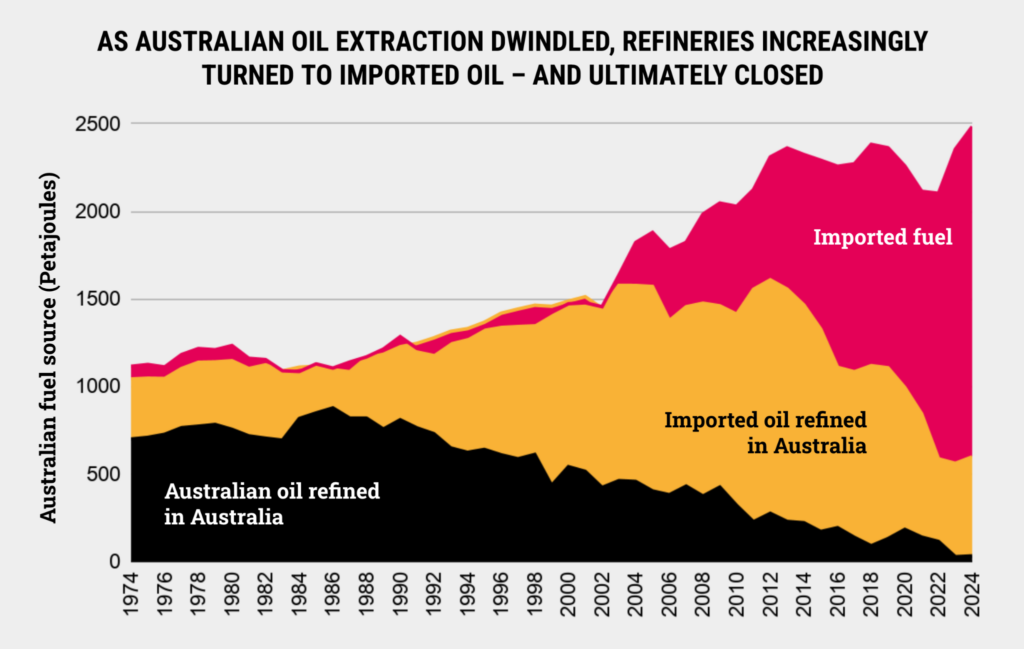
This is one of the major reasons why Australia’s oil refineries closed in the first place. Refineries were built near cheap oil reserves – like the Gippsland Basin – to produce fuel. However, this cheap and easier-to-extract oil was short-lived. The resources were quickly used up, and refineries turned to the next-best option: imported oil. Amongst this shift, larger and more efficient refineries opened in major Asian trading-hubs, some up to ten times the size of those in Australia. It no longer made sense to produce fuel in Australia, and refineries closed. This economic reality hasn’t changed.
Building a new refinery today would cost $8–10 billion upfront, take close to a decade to construct, require ongoing government subsidies to operate, and still depend on imported oil as a feedstock. Instead of just importing fuel, Australia would import oil and then pay to refine it too. That’s just throwing good money after bad.
4. Digging for more oil would only leave Australia exposed to the next energy crisis
Calls for more fuel or oil production ignores the economic reality. Even when Australia did produce the majority of our own fuel, we’ve still borne the brunt of global fuel crises.
When Australia introduced fuel rationing in 1979, 86% of our fuel was refined on Australian soil and 63% of our fuel came from domestically produced oil.1 But Australians still faced supply shortages and price spikes they couldn’t control.
When conflict disrupts a shipping lane on the other side of the world, prices at your local servo go up within days. From 1970 to 2017, global oil prices explained 70% of Australian petrol prices, and 93% of Australian diesel prices.2 It doesn’t matter how much oil Australia extracts – while we buy and sell from the same world market, we’ll always pay that price.
More recently, when Russia invaded Ukraine and global energy markets erupted in 2022, Australian coal and gas prices spiked, and power bills jumped by around $400 a year. Australia produces five times more gas than we use and ten times more coal, but this massive domestic production of gas and coal did nothing to insulate us
As long as we rely on fossil fuels, we’ll pay the price the world sets – regardless of how much we produce here.
Electrifying Australia with wind, sun and storage can shield us from global fuel shocks – and cut climate pollution
Two global fossil fuel shocks in four years have made one thing very clear: energy security means using energy that’s truly independent. Electrifying our homes, industry and transport and powering them with Australian sun and wind meets that test – and delivers additional benefits of cutting the cost of living and climate pollution.
Clean technologies are already helping to protect Australians from fuel shocks and energy price pain:
- Electric and hybrid vehicles are cutting Australia’s fuel use by 15 million litres every week – triple what it was just three years ago. In March 2026 alone, EV and hybrid owners avoided around $50 million in fuel price spikes.
- Big batteries displaced 8.1 petajoules of gas from our electricity grid between December 2025 and March 2026 – equivalent to the annual power use of 163,000 Victorian homes.
- More than 4 million Australian households have solar panels, collectively saving $3 billion a year on electricity bills. Those with solar and batteries are cutting their power bills by up to 90%.
What’s more, almost two thirds of Australians want the federal government to prioritise investment in renewables over fossil fuels. After what the past few years have cost Australians at the bowser and on their power and gas bills, that’s not surprising.
Australians want to keep the momentum behind renewables to cut climate pollution and costs – not risky oil. The challenge now is building on what’s working, faster.
1 Climate Council analysis of Australian Energy Statistics (2025)
2 Climate Council analysis, based on BITRE (2017)