
The Climate Council recommends that the Australian Government end the practice of releasing new offshore petroleum acreage, in alignment with authoritative scientific advice, international legal obligations, and the objects of the Climate Change Act 2022.
The Otway Offshore Petroleum Exploration Acreage Release should not proceed.
1. Climate change is already harming Australians
Australians are already living with the consequences of climate change, putting lives and livelihoods at risk. The 2025/26 summer saw violent swings between climate extremes, and Victoria was at the forefront, lurching from severe heat and catastrophic fires to flash floods, and back to record-breaking temperatures and dangerous fire weather in a matter of days. In the north, tropical storms and flooding rains battered communities and agriculture.
These climate consequences are the result of past policy failures to curb climate pollution. For decades, pollution from coal, oil and gas has been creating a blanket of heat-trapping gases in the atmosphere, raising the global average temperature by approximately 1.3°C above preindustrial levels (Forster et al. 2025). That additional heat is fuelling the extreme floods, heatwaves and droughts that Australians are increasingly facing.
Every fraction of a degree of global heating matters: the difference between 1.5°C and 2°C is existential for vulnerable communities, coral reefs, agriculture, and ecosystems. The future scale and severity of the climate crisis will depend on how quickly and deeply we slash global climate pollution.
The Australian Government has committed to action on climate change, including under the Paris Agreement, which aims to limit global warming to well below 2ºC above pre-industrial levels, and pursue efforts to limit warming to 1.5ºC above pre-industrial levels (UNFCCC 2015). While this commitment is codified in the Climate Change Act 2022, Australia’s climate policies are not yet aligned with either of these temperature goals.
In this context, further gas exploration is not a neutral or business as usual practice. Further gas exploration and ultimate gas extraction would fuel dangerous and increasingly severe climate impacts, but fail to meet Victoria’s energy needs reliably and affordably.
2. More gas development is incompatible with a safe future, and will harm Australians
Gas is a fossil fuel made up mostly of methane – a potent greenhouse gas. Methane is around 85 times more potent than carbon dioxide over a 20 year period, and 28 times more potent over 100 years (Climate Council 2024). Methane gas drives climate change when it leaks into the atmosphere during extraction, processing, and transport, or when it is burnt.
Scientists and energy experts have warned that fossil fuel extraction and use – including that of gas – must plummet in order to avoid the most catastrophic impacts of climate change:
- In 2023, the Intergovernmental Panel on Climate Change warned that climate pollution from the remaining life of existing fossil fuel infrastructure alone would breach the 1.5ºC temperature limit, while emissions from existing and planned infrastructure could approach the 2ºC temperature limit (IPCC 2023).
- In 2023, the IEA concluded that to limit warming to 1.5ºC, the necessary decline in fossil fuel demand negates the need for new long lead time conventional gas projects (IEA 2023).
- Climate change researchers have consistently warned that both current and projected production of gas, oil, and coal – including by Australia – exceeds levels consistent with limiting warming below 2ºC (SEI, Climate Analytics, & IISD 2025).
Despite these warnings, fossil fuel production and use have continued to increase globally (IEA 2025). Approving new exploration acreage opens the door to further gas supply, encouraging future emissions at a time when the science clearly demonstrates that fossil fuel production must decline.
With substantial evidence to demonstrate the risks of ongoing fossil fuel development, permitting further gas exploration is also a potential breach of international law. The International Court of Justice’s 2025 Advisory Opinion on the Obligations of States in respect of Climate Change finds that:
“Failure of a State to take appropriate action to protect the climate system from GHG emissions — including through fossil fuel production, fossil fuel consumption, the granting of fossil fuel exploration licences or the provision of fossil fuel subsidies — may constitute an internationally wrongful act which is attributable to that State.” (International Court of Justice 2025)
The Advisory Opinion, while non-binding, clearly indicates that decisions relating to fossil fuel exploration and licensing may engage States’ international climate obligations. In this context, the Otway Offshore Petroleum Exploration Acreage Release warrants careful assessment in relation to its consistency with Australia’s obligations under international law.
3. There are permanent, lower emissions, and lower cost options to meet Victoria’s energy needs
Victoria faces a genuine energy challenge, as its gas supplies dwindle. The Australian Energy Market Operator (AEMO) has noted that under current circumstances, peak gas demand in Victoria will exceed supply this decade, with larger annual shortfalls expected in the 2030s (AEMO 2025). While some proponents have used these circumstances to advocate for more gas extraction and exploration, this is not a meaningful energy solution for Victorians.
Gas is a fundamentally polluting and non-renewable energy source, which is now becoming increasingly expensive. Less than 10% of Victoria’s commercial gas reserves remain, and its contingent supplies are very expensive – 1.5 to 2.4 times higher than existing commercial reserves (AEMO 2025). As a result, adding new gas supplies today would likely see energy costs increase and climate pollution remain higher for longer, all while only offering a temporary solution.
In contrast, there are a number of cleaner, more permanent and cost-effective options to address Victoria’s ongoing energy needs.
In the short term, new gas extraction is not suitable to address projected short-term winter peak shortfalls projected by AEMO. Exploration, appraisal, development and connection of new offshore fields typically takes many years. For Victorian offshore gas projects operating today, the average time from discovery to production was over 20 years, with a minimum of four years for projects entering production post-2000 (Global Energy Monitor 2025).
Any gas discovered through the proposed acreage release would come online well beyond the time horizon of current forecast risks. Indeed, AEMO notes that:
“Given the lead time needed to plan, obtain approval for, and build new greenfield gas infrastructure, demand flexibility is likely the best solution to address forecast short-term supply shortfall risks” (AEMO 2025).
In the medium and long term, there are a series of options to meet Victoria’s energy needs – supported by policy reforms which are already in progress.
Most importantly, Victoria’s gas use could be dramatically reduced over the period required to explore and commission any reserves discovered within the acreage proposed for release.
Almost two-thirds of Victoria’s gas is consumed by residential users and commercial and services businesses (DCCEEW 2025). These users can already switch to electrified cooking, space heating and water heating, with efficient electric options often more cost-effective than gas options (Lovegrove et al. 2025; Treasury 2025). Victoria’s Gas Substitution Roadmap has already commenced actions to reduce gas use by these uses, with a number of significant reforms still yet to commence.
Further opportunities to reduce gas use also exist across Victorian industry. Existing technologies can replace gas for heating applications less than 400ºC, and the vast majority of Victoria’s gas use is by industries with heat needs below 300ºC (Climate Change Authority 2024).
Figure 1: Victorian gas consumption by industry in 2023-24 and typical associated heat requirement.
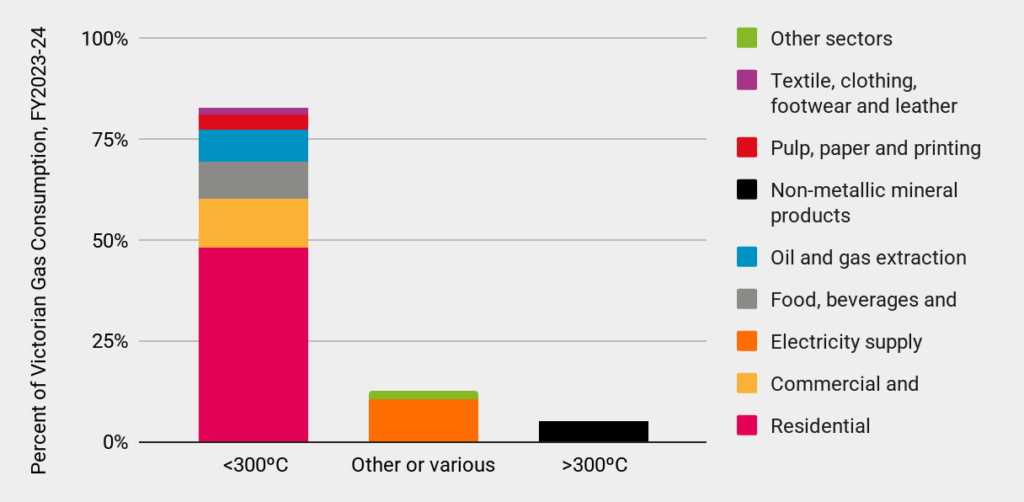
Source: Victorian gas consumption by industry from (DCCEEW 2025); typical heat requirement from (Lovegrove et al. 2025); as presented by (Smart Energy Council 2025).
While both the Victorian and Australian Governments have introduced policies to reduce gas use, the benefits of demand reduction relative to new supply have not yet been properly considered.
A genuine strategy for the transition away from gas should consider the costs and benefits of allowing new long-term gas supply, compared to more comprehensive measures to transition gas use to permanent solutions. For example, unlike transitioning away from gas use, addressing Victoria’s ongoing energy needs with new gas supplies:
- Is temporary, delaying the inevitable need to move away from gas to zero-emission options to meet Victoria’s energy needs.
- Has substantial environmental impacts, including the release of further climate pollution driving global heating, and potential damage and disruption to marine ecosystems. The impact of disruption, spills, or other catastrophic events could be significant, especially given the proposed acreage is bordered by two protected Australian Marine Parks.
- Diverts skilled labour, capital, and public resources from nationally significant industries with a long-term future, such as renewable energy, green commodities, advanced manufacturing, and services.
- Entrenches gas infrastructure from gas extraction and processing plants to distribution networks. Promoting further gas supply encourages ongoing investment in assets despite declining and uncertain end-user demand, risking stranded assets and higher decommissioning liabilities in future – with increasing risks of being passed to government, as current owners face increasing transition risk.
Conclusion
The Climate Council reiterates the warnings from authoritative scientific and legal assessments: allowing new coal, oil or gas extraction is fundamentally incompatible with limiting climate change to globally-agreed levels. At the same time, there are clear and proven options to meet Victoria’s energy needs more reliably, sustainably and affordably.
The Climate Council recommends that the Australian Government end the practice of releasing new offshore petroleum acreage, in alignment with authoritative scientific advice, international legal obligations, and the objects of the Climate Change Act 2022.
The Otway Offshore Petroleum Exploration Acreage Release should not proceed.