Australia is in the midst of a critical shift from fossil fuels to renewable energy to cut climate pollution and keep communities safer from worsening fires, floods and extreme heat. Now, a new wave of data centre development, driven largely by a surge in demand for artificial intelligence (AI), threatens to derail our progress. Some data centre proponents are actively pursuing significant new gas generation – threatening to lock in decades of additional climate pollution just as Australia needs to be cutting it further.
The Albanese Government has said it will introduce national standards to ensure that data centres are powered with additional renewables, but the Queensland and the Northern Territory governments are advocating for fossil-fuelled data centres to be allowed. Both our safety and power prices are on the line: to protect Australians from worsening climate harm and rising costs, data centres must be subject to watertight rules that require them to bring on genuinely additional renewables swiftly, with no room for polluting and expensive fossil gas as a primary power source.
The proposed Project Ares data centre is a case in point. Planned as a 1 gigawatt (GW) hyperscale AI factory at Murranji Station in the Northern Territory’s Barkly Region, it would be connected to the gas network and powered by a large new gas-fired power station. This would release more than a million tonnes of climate pollution every year despite plans to add a solar farm and battery.
Here are six reasons Project Ares rings big alarm bells:
1. Polluting fossil gas would be its primary power source for years to come
Make no mistake: if built, this data centre would be a significant, new source of climate pollution. The developer, Energy North, is marketing Project Ares as a “sustainable, renewable facility” because it might one day build some solar and a battery. In reality, the facility would be powered solely by gas in its initial years.
In other words, gas won’t just be Project Ares’s backup: it will be its primary source of power initially, and could remain so indefinitely. As we’re shifting to renewable energy and storage, fossil gas has a small and shrinking role to play in our energy mix. But it should only be used to generate electricity on the rare occasions it is needed as back up.
The proposal to use gas ahead of solar and storage doesn’t even make business sense. CSIRO’s GenCost report confirms the wait lists for gas turbines are at least five years long, while solar and batteries are available now and can be built much more quickly. Gas turbine costs are also surging – driven in large part by the global data centre boom – while battery and solar costs drop. Powering data centres with gas would lock in higher costs for operators and more climate harm for all Australians.
2. This project would use more gas than the entire Northern Territory
Even after assuming its proposed solar and battery plans are fully up and running, analysis shows Project Ares would still require around 76 terajoules (TJ) of gas per day. This is more gas than the entire Territory and all its citizens and other businesses use on average (66 TJ a day). Assuming the data centre operates at 80% capacity, with its flagged 3 GW solar farm operating at a typical 25% capacity factor, the project would burn through 3,230 gigawatt-hours of gas-fired electricity every year.
Project Ares does not yet have arrangements in place to secure this much gas, but admits it is considering gas fracked from the proposed Beetaloo Basin mega gas project. Beetaloo Energy is already proposing its own data centre in the NT to shore up domestic demand for its fracked gas – and Project Ares would add to this. If it goes ahead, Beetaloo would be one of the largest fracked gas basins in the world – a climate bomb we cannot afford to unleash, and Project Ares could help set it off.
PROJECT ARES WOULD USE MORE THAN THE NT’S ENTIRE GAS DEMAND
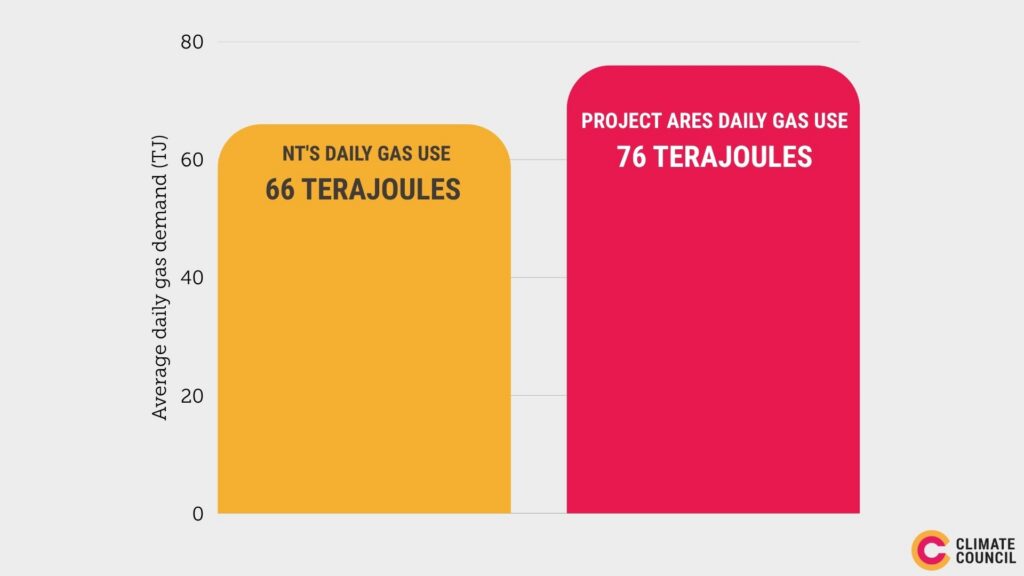
Source: Carbon Zero Initiative modelling based on the Project Ares EPBC application and the AEMO 2025 Gas Statement of Opportunities.
3. This polluting project would fuel worsening disasters already hurting Australians
Gas is a fossil fuel that produces a lot of climate pollution whenever we extract, process and burn it. The significant amount of gas Project Ares would burn equates to more than 1.4 million tonnes of climate pollution every year. It would run for at least 30 years, amounting to at least 42 million tonnes of climate pollution – or around one and a half times the NT’s entire annual emissions.
The pollution from gas (as well as from burning coal and oil) is overheating our planet and driving more intense and frequent unnatural disasters like bushfires, floods and heatwaves. Scientists are clear that if global temperatures continue to march upwards, driven by pollution from coal, oil and gas, then much of Northern Australia could become unliveable. Territorians would be severely impacted – facing extreme conditions that are only found today on less than 1% of Earth, mostly in the Sahara. We urgently need to cut climate pollution further to better protect Australians – not lock in more unnecessary gas for decades to come.
OVER ITS LIFE, PROJECT ARES WOULD RELEASE 1.5X THE NT’S ANNUAL CLIMATE POLLUTION
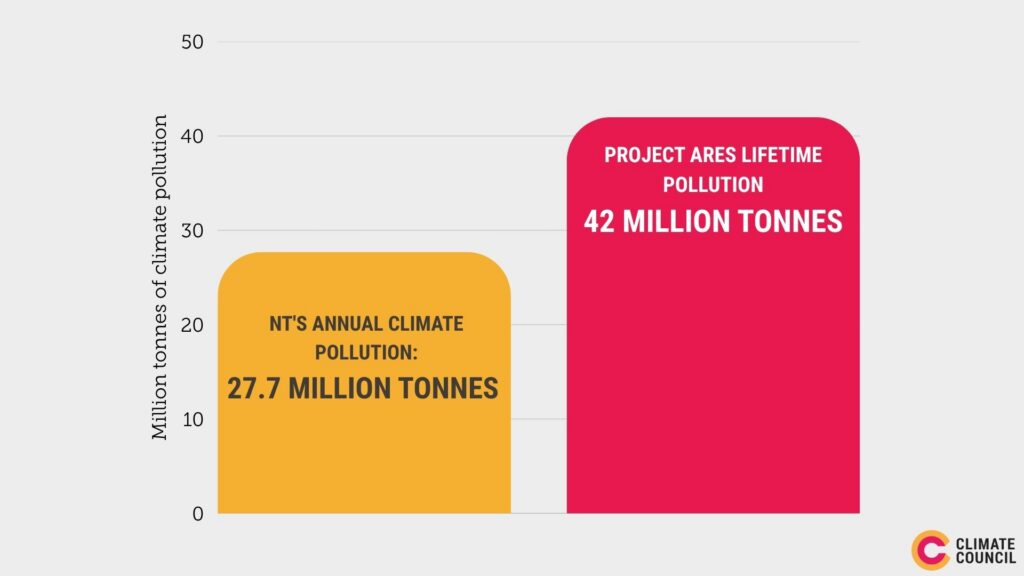
Source: Carbon Zero Initiative and Climate Council analysis based on the Project Ares EPBC application and Australia’s National Greenhouse Accounts.
4. It would undermine national climate progress
Australia is already off track to meet our 2030 and 2035 national climate targets – and the Government’s own projections warn data centres could blow us further off course if they’re powered by polluting coal and gas instead of renewables. Project Ares is a case in point: we’re set to miss our 2030 target by five million tonnes, and this one project alone could account for 1.4 million tonnes every year
5. It would put precious water resources and wildlife at risk
Project Ares proposes drawing four billion litres of water a year from the Montejinni Limestone Aquifer, which is part of a connected groundwater system that sustains nationally important wetlands, springs and waterholes, and countless animals including the endangered Largetooth Sawfish and Pig-nosed Turtle. The project area also overlaps with critical habitat for threatened species including the Greater Bilby and the critically endangered Northern Blue-tongued Skink.
6. This is out of step with what most Australians want, and what the Government has promised
The Australian Government had committed to ensure data centres everywhere in Australia bring their own additional renewable power to avoid higher pollution or power prices. But it has already made an exception to this rule to allow state-owned coal and gas assets to power data centres in some circumstances, and the Northern Territory and Queensland are pushing for weaker requirements that would put the interests of big tech and fossil fuel corporations ahead of their communities.
The vast majority of Australians (82%) agree that data centres should be required to invest in additional renewable energy and storage to match their own electricity use versus be allowed to use whatever kind of electricity they want.
Now the Australian Government needs to make sure its legislation actually delivers on its promises, and doesn’t leave the door open for projects like Project Ares to lock in massive amounts of new gas under the guise of a solar farm.
The Climate Council thanks the Carbon Zero Institute for its support in undertaking detailed modelling of the gas use and climate pollution from Project Ares.