
This web page is based on a 2025 article written for the Conversation by Climate Council Fellow Wesley Morgan and Professor Ben Newell. It has been updated by the Climate Council to reflect the developments in the first year of President Trump’s second term. Read the original article here.
If you care about protecting people and our planet from the climate crisis, you might be feeling a little down about Donald Trump’s second term as United States president. Undeniably, his return to the White House has been a real setback for federal US climate action.
Trump is a climate change denier who has put measures in place to increase fossil fuel production and stand in the way of new renewable projects, withdrawn the US from key United Nations climate treaties and organisations, and ‘taken a sledgehammer’ to the country’s climate science capabilities – with worldwide impacts.
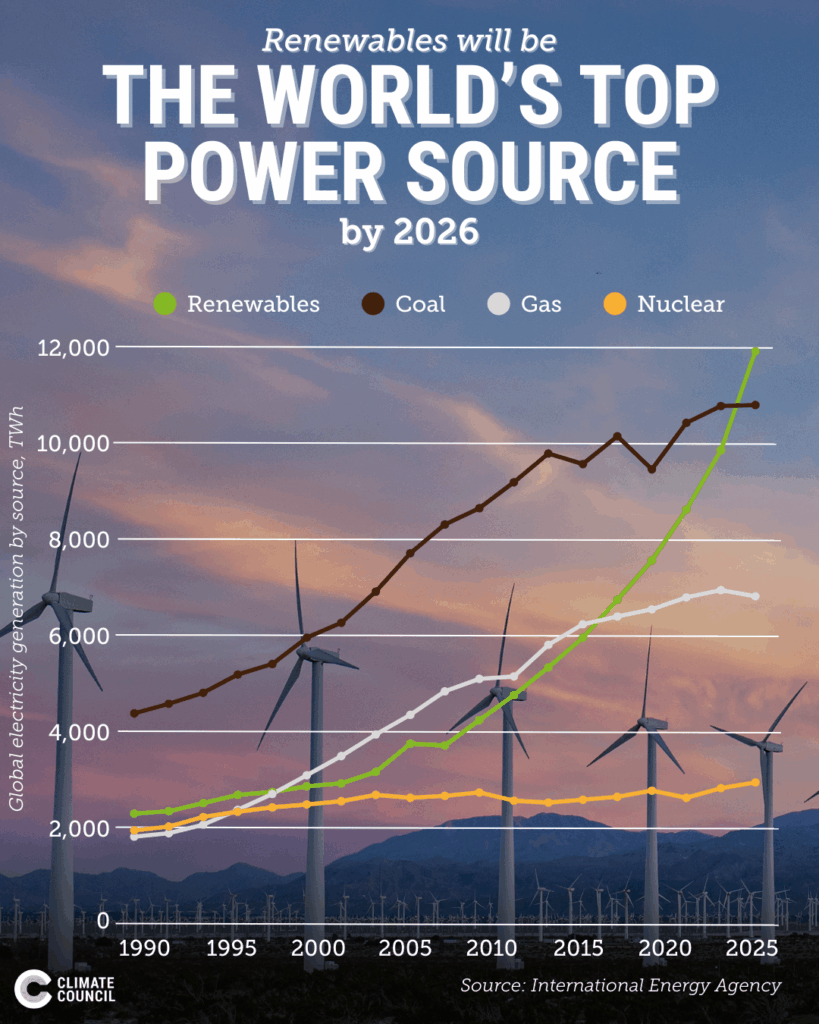
But beyond Trump and his circle, there remains deep commitment to climate action in the US. State governments are stepping up to fill the void, more than half of the country’s economy remains committed to net zero, and many US businesses are also standing strong on their net zero commitments. Globally, renewables are set to grow faster than any major energy source in the next decade, making the transition away from fossil fuels inevitable.
So now is a good time to remember that efforts to tackle the climate crisis – both in Australia and globally – are much bigger than one US President. Here are ten reasons to remain hopeful.
1. The global clean energy transition can’t be halted
The global shift to clean energy is accelerating, and Trump can’t stop it. In 2025, investment in clean energy hit AU $3.4 trillion – twice as much as global investment in coal, oil and gas. In the first half of 2025, for the first time ever, the world made more power with renewables than from coal. The record global growth in renewables prompted Science magazine to label the “seemingly unstoppable growth of renewable energy” its 2025 “breakthrough of the year”.
This is a historic mega-trend and will continue with or without American leadership.
2. US states are standing strong
Many US states have a strong history of leadership on climate change, creating the country’s first pollution control laws and clean energy standards. The states laid the foundations for the groundbreaking policies and investment under the Biden-Harris administration, and they are continuing to advance climate action at a state level. Some states are uniting to push back on the Trump administration’s anti-climate agenda. For example, a coalition of 17 states led a challenge against Trump’s order to block new wind projects, and in December 2025 a Federal judge declared that the order was unlawful.
Twenty-four US states, that together account for more than half the US population (54%) and its economy (57%), have joined the US Climate Alliance – a bipartisan coalition advancing state-led, high-impact climate action. The US Climate Alliance is just one of many organisations coordinating action across the country.
3. The economic benefits of renewables are undeniable
The International Energy Agency has confirmed that reaching net zero by 2050 will lead to a clear decline in total household energy bills (including power, gas and fuel) in advanced economies like Australia and the US. At the same time, technological innovation, competitive supply chains, and economies of scale, mean that more than 90% of renewable projects are cheaper than fossil fuel projects. Renewables also offer reduced dependence on international fuel markets and improved energy security.
These benefits are making the economic argument in favour of renewables stronger, even as the Trump administration cuts subsidies. Even Republican-controlled states like Iowa, Texas, and Montana were all early adopters of renewable energy, in pursuit of economic development and energy independence. Texas was the country’s leading installer of solar in 2025.
4. Many US businesses are also standing by their climate commitments
Globally, more companies than ever before are making climate commitments, because they recognise that action on climate change can reduce energy costs, expand their market share, protect their business from risks and secure long-term growth. Between 2023 and 2025, there was a 227% increase in companies setting comprehensive climate targets.
As global markets and consumer preferences shift towards clean technologies, many US businesses are also standing strong on their net zero commitments. 2025 analysis found that 84% of US companies are standing by their climate commitments. 37% of companies are even increasing their efforts to cut climate pollution while only 16% of companies are weakening their commitments.
5. China is charging ahead as a clean energy juggernaut
China, the world’s second largest economy, has been the largest polluter since 2006 – when it overtook the US. Over the past two decades, however, China has been rapidly expanding renewable energy and electrifying homes, businesses and transport to improve its energy security and independence as its economy grows.
Since 2020, China’s solar capacity has almost quadrupled and its wind capacity has doubled. Record-breaking investment in 2024 saw China achieve its 2030 renewable target six years early. Importantly, this impressive renewable build out has helped displace coal: China’s coal generation dropped in 2025 for the first time since the 1970s. China’s emissions are now showing signs that they’ve peaked, five years ahead of projections – signalling a major milestone in global climate action.
Now, the country aims to cut climate pollution by 7-10% over the next decade by expanding renewables, promoting electric vehicles, and achieving overall cuts to climate pollution.
Find out more in our report Power Shift: The US, China and the Race to Net Zero.
6. Other major economies are also powering ahead with clean energy
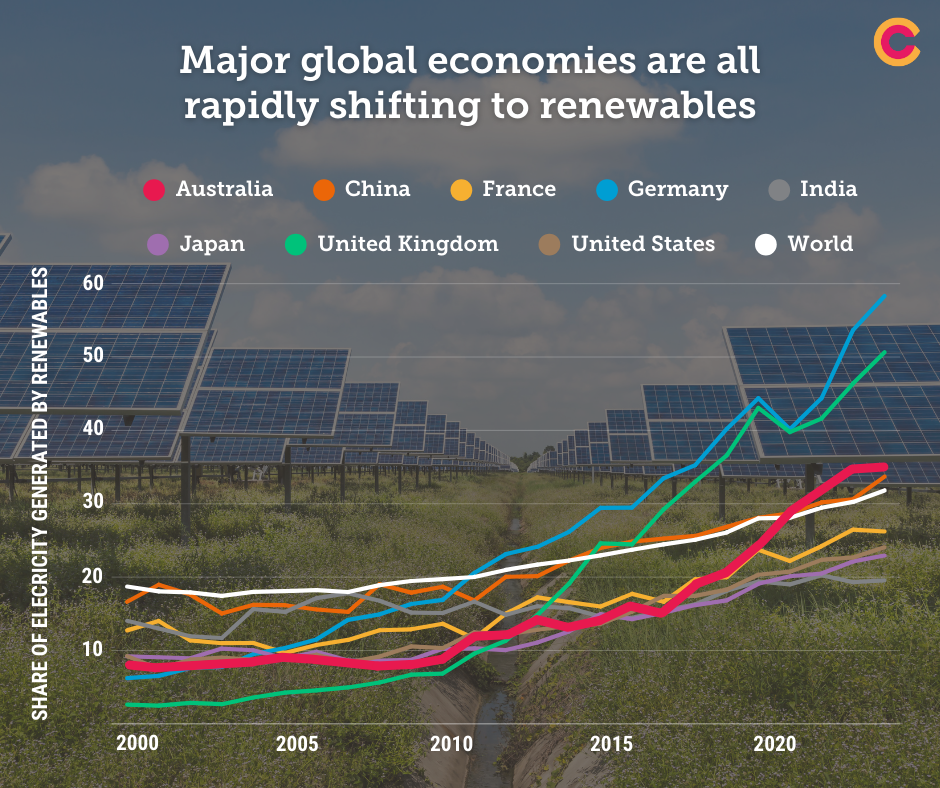
Other major economies including the UK, India and the EU, as well as Australia’s key trading partners like Japan and South Korea, are all pushing ahead with the renewable rollout.
The UK has already phased out coal-fired power generation, along with six EU countries. India has reached its target of 50% non-fossil power capacity five years early, paving the way for a faster switch to renewables. South Korea has recently committed to phasing out most of its coal fired power plants by 2040. As one the world’s top coal importers, and one of Australia’s largest coal customers, this signals a major shift for the global industry.
7. Global climate cooperation is bigger than Trump
Despite Trump’s withdrawal from key climate treaties including the Paris Agreement, other countries remain committed. When the Paris Agreement was signed in 2015 no countries had formal net zero targets. Now, 83% of the global economy has a net zero target. Analysis shows that climate targets are becoming more robust over time, covering more sectors and greenhouse gases. The majority of countries also have targets to increase renewable generation.
A lack of national leadership in the US has created opportunities for other countries to step up on the global stage. For example, as China looks to grow its productivity, it is committed to supporting the global shift to renewables, helping to build its clean technology industries. President Xi Jinping has committed to remain a “steadfast actor and major contributor in promoting global green development” and work with the international community to “overcome the headwinds and steadily move forward global climate governance”.
8. More than 80 countries have called for a roadmap to phase out fossil fuels
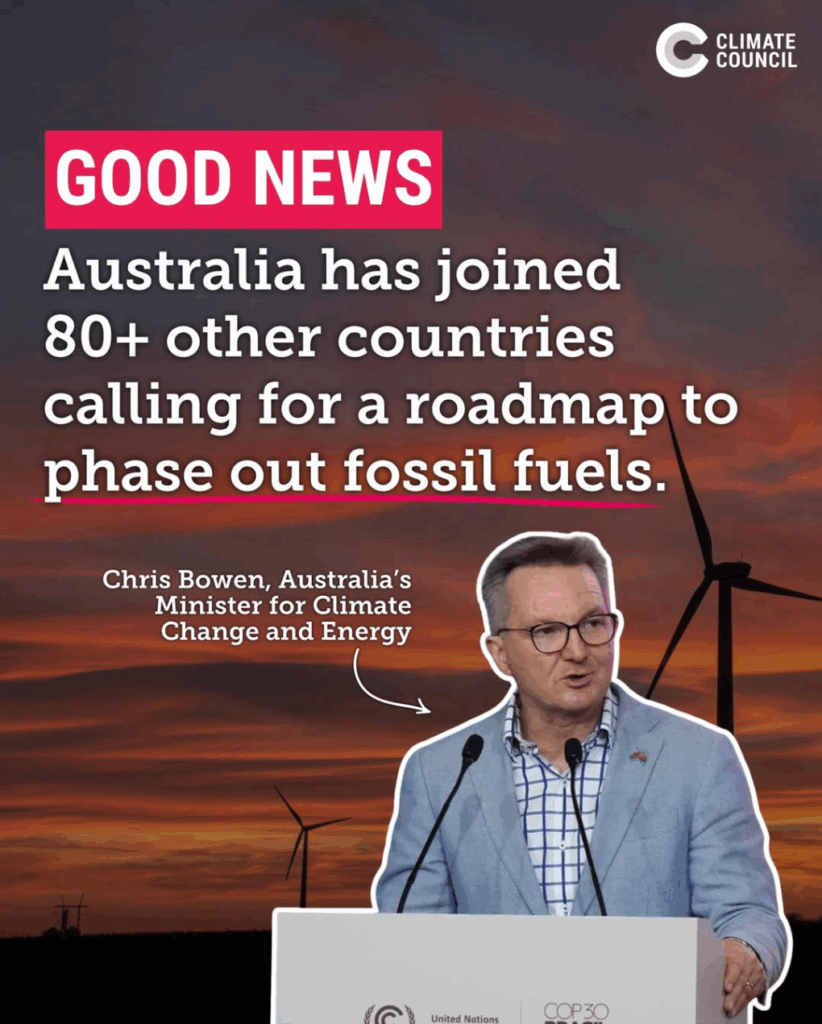
While the US was absent from the 2025 global climate summit – COP30 in Brazil – several important breakthroughs were achieved. Importantly, Australia joined more than 80 countries in signing the Belem Declaration. Led by Colombia, the Declaration commits countries to work together towards a “just, orderly and equitable” transition away from fossil fuels, consistent with limiting average global heating to 1.5°C.
The Belem Declaration is non-binding, which means countries aren’t legally required to take action, BUT it’s the strongest language we’ve seen from the Australian Government, and many others, about the need to switch away from fossil fuels. It is an important mechanism to hold our governments to account in phasing out polluting coal, oil and gas.
9. The world’s highest court has confirmed countries have a legal obligation to tackle climate change
In a landmark case in July 2025, the world’s highest court – the International Court of Justice – advised that all countries have a legal obligation to protect and prevent harm to the climate, and can be held liable for climate change damage. While the court’s advisory opinions are non-binding, they can still have a powerful impact on countries, both legally and politically. The case will reverberate across the world – in courtrooms, boardrooms, Parliaments and international negotiations.
10. Australia’s clean energy shift is accelerating
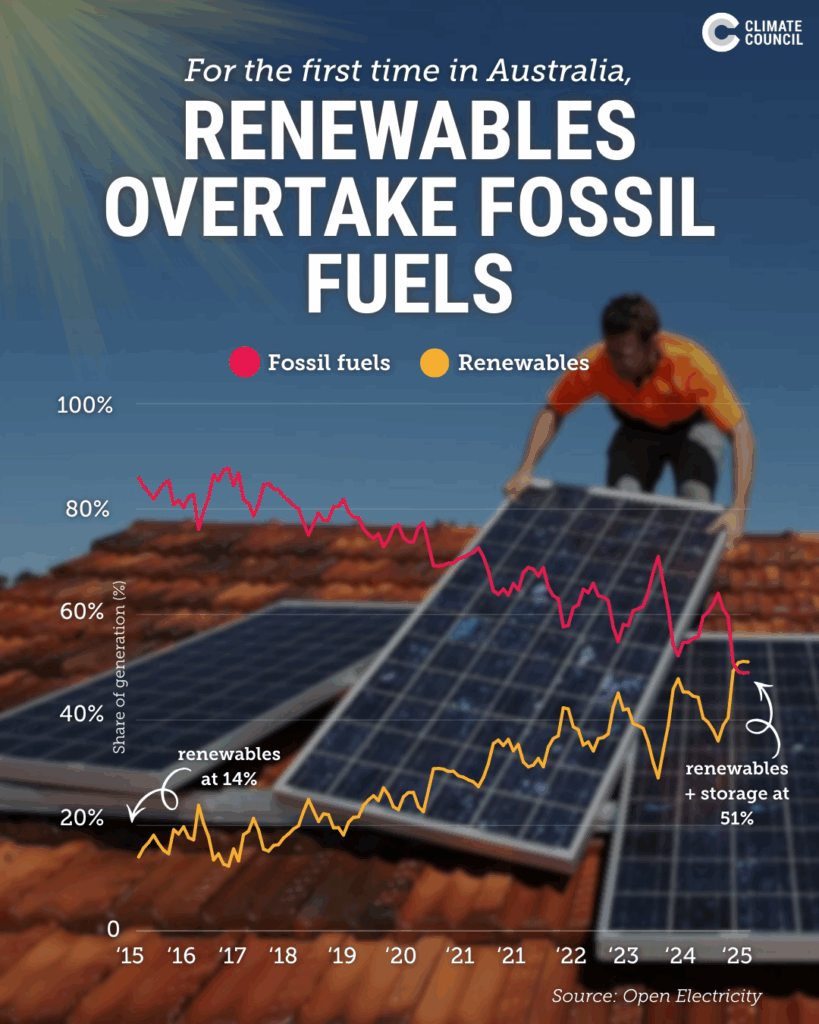
Throughout 2025, 43% of Australia’s main national electricity grid was powered by renewables. In October 2025, we hit a major milestone: renewable energy and storage overtook fossil fuels to power 51% of Australia’s main grid. Compare this to the same month a decade ago, when renewables provided just 14% of our power.
Australians love clean energy: one in three households have rooftop solar installed, making us a world-leader in the technology’s uptake, and two million homes and businesses are expected to install batteries to soak up their excess solar power by 2030. Trump’s occupation of the Oval Office cannot stop this momentum.
On gloomy days, it might feel like humanity won’t rise to our biggest existential challenge. But there are many reasons for hope. The vast majority of us support policies to tackle climate change, and in many cases, the momentum is virtually unstoppable.