In short
While everyday Australians tighten their belts, big mining corporations are pocketing billions in government fuel subsidies, padding their profits and pumping up pollution.
What’s next?
The Albanese Government can end this free ride for fossil fuels with a $50m cap that stops the corporate rorting without affecting a single farmer, truckie, or tradie.
WHAT IS THE DIESEL FUEL REBATE?
The Fuel Tax Credit (FTC) Scheme is a federal government subsidy that refunds the fuel excise – currently 52.6 cents per litre – to businesses that use diesel “off-road”, like miners and farmers, or for heavy vehicles.
The Federal Budget shows this massive tax break will cost Australian taxpayers nearly $13 billion per year.
WHO BENEFITS FROM THIS MASSIVE TAX BREAK?
While everyday Australians are tightening their belts, mining corporations are cashing in on this $13 billion dollar fossil fuel subsidy.
The mining sector dominates the scheme, claiming 47% of fuel tax credits. The top 18 mining beneficiaries collectively cashed in on $3.36 billion of credits last year alone. The average coal mining company claims $26 million a year in fuel tax credits.
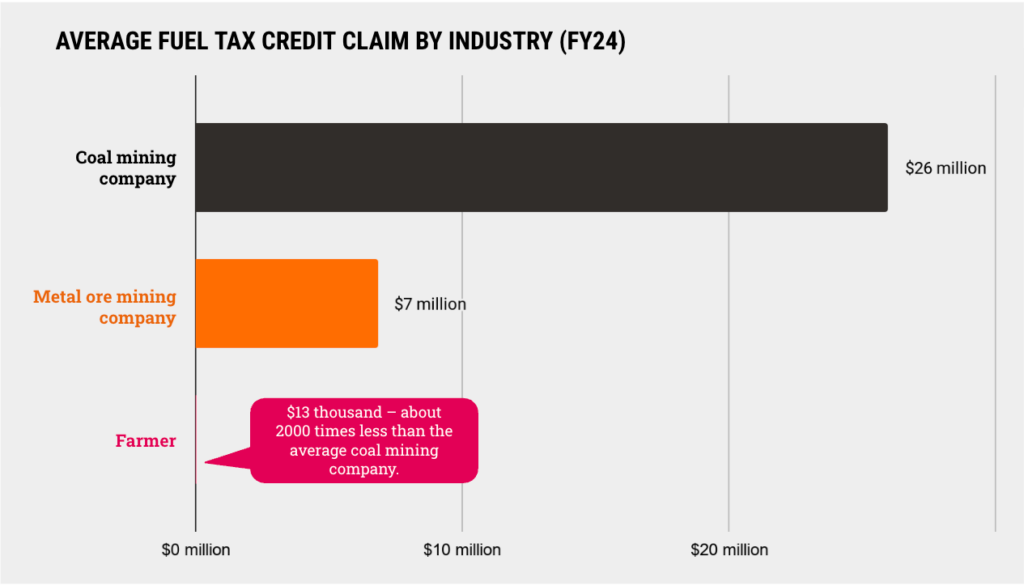
Compare that to the agriculture sector, which receives 12% of fuel tax credits spread across thousands of operations. The average farmer receives just $13,000 in fuel tax credits, a tiny fraction of the $26 million claimed by the average coal mining corporation.
WHY IS THE GOVERNMENT PAYING BIG MINERS TO PUMP UP THEIR PROFITS AND POLLUTION?
Those same companies cashing in on government handouts are posting massive annual profits: BHP reportedly received $622 million in fuel tax credits in 2024 while posting around $10 billion in profit.
And the worst part is, the mining industry has the cash and technology to switch to cleaner transport like electric trucks, but are choosing to cash in on diesel fuel credits instead. This is in stark contrast to farmers, who have fewer clean energy options, and less cash to fund new equipment.
In BHP’s own climate strategy, it committed to trialling electric trucks from 2024 and rolling them out across its fleet in 2027-28. But a recent investigation revealed that BHP has spent more than $500 million on new diesel trucks and chosen to hit the brakes on its shift away from diesel trucking.
Part of the problem is the diesel fuel rebate, which actively incentivises big mining companies to continue using diesel and undermines decarbonisation. According to analysis by mining company Fortescue, a 51.6 cents per litre fuel tax credit halves return on investment for electrification.
WHY SHOULD THE GOVERNMENT REFORM THE DIESEL FUEL REBATE?
This policy actively undermines the Australian Government’s energy and climate goals, by incentivising big polluters to stick with diesel instead of switching to clean alternatives that would cut climate pollution.
Pouring billions of taxpayers dollars into imported diesel for mining corporations leaves all Australians exposed to global energy shocks and does nothing to accelerate the shift to secure, domestic energy sources.
Every dollar spent subsidising mining diesel is a dollar unavailable to support farmers, regional communities and industries to make the switch to cleaner, more secure energy.
BUT ISN’T THE FUEL EXCISE LINKED TO ROAD USE?
That is an outdated myth. The fuel excise originally funded roads, but today most of it goes towards general government revenue – the exact same pool of public money used to fund our hospitals, schools, and emergency services.
Mining corporations are effectively getting a multi-billion-dollar discount for using diesel which the rest of us can’t access. This makes no economic or policy sense.
IT’S TIME TO END THE FREE RIDE FOR FOSSIL FUELS WITH A $50M CAP
The Albanese Government can end this free ride for fossil fuels by phasing out fossil fuel subsidies, starting with a $50m cap that stops the corporate rorting without affecting a single farmer, truckie, or tradie.
Placing a $50 million annual cap per company on the fuel tax credit scheme would save taxpayers $2.5 billion per year – and only affect 18 large resources corporations.
These savings could be spent on support for farmers to invest in electric machinery that has high upfront costs, or used to deploy up to 50,000 new electric trucks across the nation to free up to one billion litres of diesel per year.
No farmer, truckie, or tradie would be impacted by this reform, as their claims sit well below the $50 million annual cap.